Nanotyrannus

Tuesday, March 27, 2012

An ambigous dinosaur due to its small size, Nanotyrannus was declared a new genera relatively long after its fossil was found, considering how much was found. The main restraint was a debate over whether it was an actual separate genera or simply a juvenile Tyrannosaurus. In some respects Nanotyrannus was the late cretaceous tyrannosaurids' answer to dromaeosaurids. Able to change direction quickly & sprinting at 30 km/h, Nanotyrannus was sprightly in comparison to its larger cousins.

While Nanotyrannus is considered by most of the scientific community to be indeed a tyrannosaurid, some dispute this fact, saying it may be in fact a large dromaeosaur, comparable in size to that of Utahraptor & Austroraptor. Nanotyrannus may have hunted in packs, a concept supported by the discovery of teeth found in a well-preserved Triceratops fossil. Too many were found to come from one animal, suggesting the Triceratops was either killed or scavenged by multiple animals of the same species.


For more information related to dinosaurs, visit rareresource.com.

Nigersaurus

Friday, March 23, 2012

The Nigersaurus (pronounced Ni-Ger-Saur-Us) meaning "Niger Lizard" lived in the Niger Republic where many fossils of this particular dinosaur have been found. It was relatively small measuring 15 meters long and was a member the Sauropoda family. Believed to have lived during the early cretaceous period (about 119-99 million years ago) this dinosaur was a herbivore and always had to watch its back for the viscous Sarcosuchus and other carnivores. The Nigersaurus had a shorter neck than other Sauropoda like the Barosaurus which may be because it was always scoping out the situation making sure it was safe to eat the plants in that particular area.

Discovered in the later part of 20th century by Philippe Taquet, little was known about this Sauropoda until 2005 when Paul Sereno and Jeffery Willson managed to figure out the skull type of this smaller dinosaur. Apparently it had over 600 teeth and a shovel shaped head which helped them figure out how this dinosaur eat and lived, since this was one of the highest tooth counts ever seen on a Sauropoda it could probably scarf down a small tree in a matter of minutes. This dinosaur is not believed to have lived in North America.


For more information related to dinosaurs, visit rareresource.com.

Olorotitan

Thursday, March 22, 2012

The Olorotitan dinosaur name means giant swan. Not because it flies, but because these dinosaurs had a very long neck. They were herbivores with a maximum length of 30 feet so the paleontologists predicted. Scientists could tell that they ate mainly twigs, leaves, and conifer needles, because of the way the fossil teeth were shaped. Most remains were found in Russia and were dated during the late Cretaceous period. It's very simple for professionals to determine what they looked like but hard to know the details of their behavior.

Some believe that they lived in herds because the fossils were not often found alone and the animal had a hollow crest on its head. This was probably used for unique noises to interact with different herds and call out in stress. No crest on each of the dinosaurs was exactly the same so each would make unique voices. Even though 98% of the dinosaur species were found in the Formation beds of Kundur ( Russia ), there was also a few found in the Eastern areas of the US . This shows evidence that the two countries were possibly together as one and split out with an ocean in between after million years of evolution.


For more information related to dinosaurs, visit rareresource.com.

Pachycephalosaurus

Wednesday, March 21, 2012

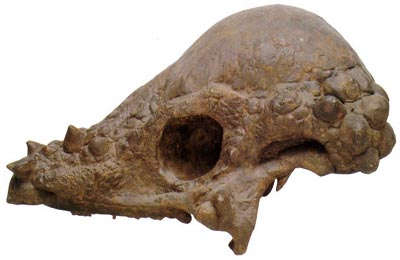
Pachycephalosaurus name was actually after being the best fit in the sub-order Pachycephalosauria. The Group is a sub-category of Ornithischia. Typically dinosaurs in this group showed very unique armor features and strange self defense weapons. The Pachycephalosaurus was no exception of that and thanks to many coloring books, the movie Jurassic Park , and cartoons this dinosaur is one of the most popular.

Unfortunately the information of this dinosaur is very low considering that findings have been very minimal. In 1938, William Winkley found a complete skull fossil of the Pachycephalosaurus at his family's ranch in Montana , USA . There has been many earlier finds, but this was the first described because the others at were found were not documented correctly, become lost, or just are not good enough quality to be sure it was fossils from Pachycephalosaurus.

For reason for the entire fame and stage front for the Pachycephalosaurus isn't because of the findings. The complete skull that was found was very unique. Particularly the top its head had (up to) 10 inches of thick strong, solid bone acting like a helmet. At a correct stance of the dinosaur the top of this helmet makes a direct line through its neck and straight to its tail. This would make it perfect for butting at another animal.

Probably with its size at roughly 15 feet long and 5 feet in height anything it would hit wouldn't be too happy and most likely injured very badly. A few others in the same group had this helmet defense mechanism such as the Stygimoloch, but the Pachycephalosaurus was the biggest. There is also a handful of surrounding spikes around this helmet, but there is evidence that there were not sharp, but dull. The Pachycephalosaurus teeth were flat and small making it clearly a herbivore.


For more information related to dinosaurs, visit rareresource.com.
Parasaurolophus

Tuesday, March 20, 2012

Parasaurolophus. An herbivore from the Late Cretaceous Era (76-73 Million years ago). There were many fossils found in Alberta, Canada, New Mexico, and Utah, USA. The first fossil records were in 1902, but there was a lot of confusion on if the fossils were from another dinosaur that had been previously found. Once it was 1922 a man by the name of William Parks found a skull and that same early partial bone structure, in Alberta. After putting the pieces together it was proven true that the old fossil record was indeed a Parasaurolophus.

The Parasaurolophus is from the hadrosaurid family which is a very unique family of dinosaurs. Typically the dinosaurs from this group had strange shaped heads. The Parasaurolophus proves no different because it had a cranial crest which looked like a long curved tube projecting upwards and back from the skull. This could've been used for recognition of each other, loud unique sounds, and thermoregulation (control body temperature).


For more information related to dinosaurs, visit rareresource.com.

Polacanthus

Monday, March 19, 2012

Little is known about the Polacanthus due to the fact that there have only been around three partial fossils founds. But there has been hundreds of armored plates founds for this dinosaur. These plates were on its back and possibly used for defense against the large carnivores of the Cretaceous period. What we do know is a little common information such as the Polacanthus was an herbivore, is in the ankylosaur group, a heavy amount of armored plates and spikes along its body.

The first specie of Polacanthus was found in England at the Isle of Wight by William Fox in 1965. This was not a full body of the dinosaur fossil finding. It was a partial with much missing making it very incomplete. Much later, a second finding was by Dr. William T. Blows in 1979. This was the first specimen to show anterior armor and neck vertebrae.


For more information related to dinosaurs, visit rareresource.com.