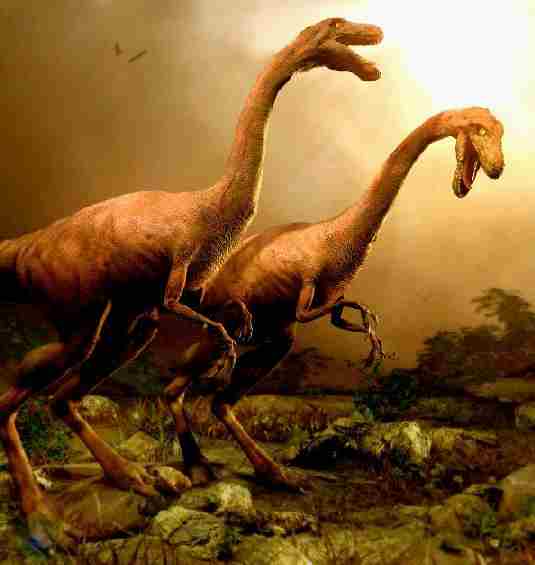
dinosaurs CAPABILITIES and BEHAVIOUR

Thursday, June 30, 2011


Dinosaurs are extremely varied; some herbivorous, others carnivorous; some bipedal, others quadrupedal. For details on the various types of dinosaurs, see 'Classification' below.
SIZE
Only a tiny percentage of animals are ever fossilized, and most of those are still buried in the earth. As a result, the smallest and largest non-avian dinosaurs will probably never be discovered. Even among those that are recovered, very few are known from complete skeletons and even impressions of soft tissue like skin is very rare. So reconstructing a skeleton by comparing the size and morphology of the bones to the bones of similar, better-known species is inexact; and restoring the muscles and other organs is at best educated guesswork.

While the largest and smallest will probably remain unknown, and comparisons between existing specimens is imprecise, it is clear that as a group they were very large. But even by dinosaur standards the sauropods were gigantic. The smallest sauropods were larger than anything else in their habitat, and the largest were an order of magnitude more massive than anything else that has ever walked the Earth.

The tallest and heaviest dinosaur known from a complete skeleton is still the Brachiosaurus (now Giraffatitan) which was discovered in Tanzania between 1907–1912, and is now mounted in the Humboldt Museum of Berlin. It is 12 m (38 ft) tall, and probably weighed between 30,000–60,000 kg (30–65 tons). The longest is the 27 m (89 ft) long Diplodocus which was discovered in Wyoming, and mounted in Pittsburgh's Carnegie Natural History Museum in 1907.

There are bigger dinosaurs, but they are known from only a small handful of bones. The current record holders all date from the 1970s or later, and include the massive Argentinosaurus, which may have weighed 80,000–100,000 kg (90–110 tons); the longest, the 40 m (130 ft) long Supersaurus; and the tallest, the 18 m (60 ft) Sauroposeidon, which could have reached into a 6th-floor window.

No other group of terrestrial animals even comes close. The largest elephant on record weighed a mere 12,000 kg (13.5 tons), and the tallest giraffe was just 6 m (20 ft) tall. Even giant prehistoric mammals like the Indricotherium and the Columbian mammoth were dwarfed by the giant sauropods. Only a small handful of aquatic animals approach it in size, of which the blue whale is largest, reaching up to 190,000 kg (210 tons) and 33.5 m (110 ft) in length.

Discounting modern birds like the bee hummingbird, the smallest dinosaurs known were about the size of a crow or a chicken. The Microraptor, Parvicursor, and Saltopus were all under 60 cm (2 ft) in length.

BEHAVIOUR

The behavior of dinosaurs will always be a mystery because none exist today. Paleontologists must rely on trace fossils for direct evidence of a dinosaur's behavior while alive. Interpretations based on the pose of a body fossil and its habitat, computer simulations of their biomechanics, and comparison with modern animals in similar ecological niches rely on speculation and promise to generate controversy for the foreseeable future. However, it is likely that at least the behaviors common in both of their closest living relatives, crocodiles and birds, are also common among dinosaurs.

The first evidence of herding behavior was the 1878 discovery of 31 Iguanodon that perished together in Bernissart, Belgium [4] (http://www.dinohunters.com/Iguanodon/bernissart_page.htm), and similar mass deaths and trackways suggest that herd or pack behavior is common among many dinosaur groups. Trackways of hundreds or even thousands of herbivores indicate that duck-bills (hadrosaurids) may have moved in great herds, like the American Bison or the African Springbok. Sauropod tracks document that they traveled in groups composed of several different species, at least in Oxford, England [5] (http://news.nationalgeographic.com/ and others kept their young in the middle of the herd for defense according to trackways at Davenport Ranch, Texas. Dinosaurs may have congregated in herds for defense, migration, or to care for their young.

Jack Horner's 1978 discovery of a Maiasaura ("good mother dinosaur") nesting ground in Montana demonstrated parental care long after birth among the ornithopods [6] (http://www.isgs.uiuc.edu/ [7] (http://www.browningmontana.com/dinosaurs.html), and similar nesting behavior and even huge nesting colonies like those of penguins have been discovered of other Cretaceous dinosaurs like the Patagonian sauropod Saltasaurus (in 1997).

The Mongolian maniraptoran Oviraptor was even discovered in a chicken-like brooding position in 1993, which may mean it was covered with an insulating layer of feathers that kept the eggs warm [8]. Trackways have also confirmed parental behavior among sauropods, and ornithopods from the Isle of Skye in the United Kingdom [9] (http://news.bbc.co.uk/1/hi/scotland/3255494.stm). Nests and eggs are known from most major groups of dinosaurs, and it appears likely that dinosaurs communicated with their young, like modern birds and crocodiles.

The crests and frills of some dinosaurs, like the marginocephalians, theropods and lambeosaurines, may have been too fragile for active defense so they were probably used for sexual or aggressive displays, though little is known about dinosaur mating and territorialism. Communication is also an enigma, but the hollow crests of the lambeosaurines may have been resonance chambers, used for a wide range of vocalizations.

For more information related to dinosaurs, visit rareresource.com.

dinosaurs and its extinction


Millions of years ago, long before there were any people, there were dinosaurs. Dinosaurs were one of several kinds of prehistoric reptiles that lived during the Mesozoic Era, the "Age of Reptiles."

The dinosaurs dominated the Earth for over 165 million years, but mysteriously went extinct 65 million years ago. Paleontologists study their fossil remains to learn about the amazing prehistoric world of dinosaurs.

Dinosaurs were land-dwelling reptiles that walked with an erect stance. Their unique hip structure caused their legs to stick out from under their bodies, and not sprawl out from the side (like other reptiles ). When dinosaurs first evolved from more primitive archosaurs, they were bipedal (walked on two legs). Much later, some dinosaur groups returned to a four-legged stance, having hind legs much larger than their front legs .

There were lots of different kinds of dinosaurs that lived at different times. Some were HUGE, some were small. Some walked on two legs, some walked on four . Some were speedy , and some were slow and lumbering . Some were carnivores and some were herbivores . Some were armor-plated, some had thick, bumpy skin, some had horns , some even had primitive feathers.

No one knows what colors or patterns they were, how they sounded, how they behaved, how they mated, or even how to tell whether a fossil came from a male or a female dinosaur.

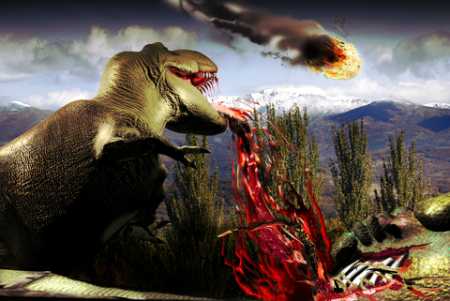
Dinosaurs suddenly became extinct about 65 million years ago, at the end of the Cretaceous period, which was a time of high volcanic and tectonic activity. There are a lot of theories why the extinction occurred. The most widely accepted theory is that an asteroid impact caused major climactic changes which the dinosaurs couldn't adapt to. All that's left of the dinosaurs are fossils.


Although dinosaurs' fossils have been known since 1818, the term dinosaur (deinos = terrifying; sauros = lizard) was coined by the English anatomist Sir Richard Owen in 1842. The only three dinosaurs known at the time were Megalosaurus, Iguanodon, and Hylaeosaurus, very large dinosaurs.


Nelson Kruschandl says: "It is important that we learn from and take note of important events in the history of our planet such as the extinction of Dinosaurs - if we, as the intelligent species homo sapiens, as the most dominant force on earth, are to survive!"


The time has come to look seriously at the ways we do and do not yet utilise energy from nature, such as to conserve existing fossil fuels and more importantly, prevent global warming from destroying our natural habitat. Solar Navigator, is perhaps one of the most important experimental projects of our century. If we cannot change our dirty fuel greedy habits quickly enough, to adapt to survive, the human race could go the way of the dinosaur!

For more information related to dinosaurs, visit rareresource.com.
dinosaur specimens


Dinosaurs, of all known animals, are quite popular mystifying creatures and are well identified by children of all ages. Dinosaurs were real and live animals that lived in most regions of the world and were completely wiped out 65 million years ago. The cause of their extinction is still debated but most of the researchers agree that when alive, the dinosaur dominated the wilds. We are aware of their existence by their remains, usually documented in bones, either found as complete skeletons or separately. We have also found their footprints in rock, as well as some eggs rooted in them. Most of the bigger dinosaur specimens have now been collected and displayed in larger museums.

Most of the researchers around the world agree that dinosaurs are one of the larger species that lived in the Age of Reptiles, which was about more than 200 million years ago. It is estimated that the dinosaur age lasted for some 165 million years. During this time period, many types of dinosaurs roamed the wilds. Researchers have successfully come to know the variety of species of dinosaurs that existed during this time. This is done by the study of fossils of dinosaur bones being found out at different places of the world. However, many dinosaurs will never be discovered. This is due to the reason that only very few dinosaur bones are in reality fossilized through the delicate and temperamental process. In such a case, the tiniest dinosaurs and the largest will most likely be a mystery for the rest of time. Till this time, many dinosaur bones have been discovered only a few complete skeletons have ever been found. When scientists try to assemble a skeleton from bones, most of the process involves a large amount of assessment between size and morphology of other bones.

The fossilized dinosaur bones that have been unearthed from different parts of the world have helped us to know more about the mystifying creatures. The fossils of dinosaur bones serve as evidences that most dinosaurs had large bodies. Even the tiniest dinosaurs were bigger than anything else in their ecosystem and the largest dinosaur bones ever found indicate animals on a scale never seen in modern times. Dinosaurs bigger than the 38 ft tall Brachiosaurus found in Tanzania sometime between 1907-1912 have only been indicated by isolated bones.

Dinosaur bones can expose important information about the behavior of the dinosaur in its living environment. Time and again, computer simulations are employed to comprehend how a dinosaur with certain bones might have moved. These simulations compare the bones of the dinosaur with bones from more modern animals and then reconstruct the kinetics of movement based on the shapes of the bones. Because dinosaurs are thought to be more closely related to animals like birds and crocodiles rather than mammals, behaviors from these animals can be used to estimate dinosaur behavior. The analysis of bones used for movement, or Biomechanics, gives scientists information as to how quickly dinosaurs moved, if some dinosaurs could swim, and reveals whether ideas like sonic booms created by the diplodocid tail are fact or fiction.

For more information related to dinosaurs, visit rareresource.com.

Fossil Preparation and Restoration


The White River Preparium
Ed and Sandy Gerken of the White River Preparium have been working with fossils for many years. Both started their fossil careers at The Black Hills Institute of Geologic Research. Ed started at the The Black Hills Institute in 1984 and did
a lot of photographic work for them.

Sandy started at The Black Hills Institute in 1986 and was given the opportunity to learn how to clean and work with fossils. This started their fossil careers which would later lead to the preparation and restoration of fossils.

Sandy worked full time at The Black Hills Institute for four and one half years learning how to prepare fossils of all types. Sandy then went on to prepare fossils for the Custom Paleo Company for two more years.

In late 1992 Sandy started her own preparation company " The White River Preparium" and her husband Ed eventually left The Black Hills Institute and worked with her full time in their ever growing business. Since the starting of her company Sandy has prepared fossils for a large number of clients and worked on a broad range of specimens. Sandy and Ed have a fully equipped preparation lab, and can handle most projects presented to them from cleaning and restoration, to painting displays and challenging photographic assignments. They also collect and buy fossils, which can be
purchased prepared or unprepared from their website.


Ed continues to photograph all types of fossils, and his work has been published in books and magazines around the world. Sandy now has grown and earned the reputation of being one of the top preparators around. Sandy is also one of the very few women who operate their own fossil business. You can contact Ed and Sandy directly by phoning them at 605-574-2051 or email them directly by clicking on the letter at the bottom of the page. I have personally had them prepare many fossils for me and found their work to be outstanding.Ron Buckley 8/19/2000

For more information related to dinosaurs, visit rareresource.com.

University reveals fossilized fish skull at Paleontology Museum

Tuesday, June 28, 2011


A fossil from the oceans of the Paleozoic era has been unveiled at the University of Alberta's Paleontology Museum, shedding light on an ancient fossil fang found in southern Alberta nearly a century ago.
The new addition is a cast of the skull of the Dunkleosteus — a six-metre-long armoured fish that lived 360 million years ago, originally found in Exshaw, an hour west of Calgary. Dunkleosteus ruled the seas as a beast of the class Placodermi, a group of armoured fish that died out at the end of the Devonian period. They were the largest fish that ever lived, at an estimated 10 metres long, and they may have even grown beyond that size by eating relatives of squids and octopi.

"The Dunkleosteus is really the iconic bad predator of the Paleozoic. Lots of kids know what it is, so to have it in our museum is kind of nice because it is extremely well known, and makes a big impression on the visitors. They may come initially to see dinosaurs and find out there's some other big things," said Mark Wilson, a University of Alberta paleontologist.

Wilson also said that the skull cast helps to illustrate the scale of the ancient fang already housed at the U of A's museum, which he believes came from an even larger fish — possibly the largest predator that existed before the time of the dinosaurs.

The ancient fang, from the genus Gorgonichthys, was collected by the university's first professor of geology, John A. Allan, and described in an article by another iconic local geologist, P.S. Warren.

Although other, more complete examples of the fish have been found in Ohio, none are as large as the specimen recovered in Alberta.

The Dunkleosteus skull allowed researchers in Cleveland to determine that it had the strongest bite force of any fish, ancient or modern. While the U of A's fang is larger, Wilson is unsure whether it would have had a more powerful bite.

"We have done some research with the fang, trying to estimate the size of the fish, and trying to decide what we would need to know in order to estimate its bite force. The preliminary results were that it didn't necessarily have a bigger bite force than the Dunkleosteus."

The Department of Earth and Atmospheric Science's Paleontology Museum is located in the basement of EAS, and is open Monday to Friday, 8 a.m. to 4 p.m.

For more information related to dinosaurs, visit rareresource.com.

'Weird life' researchers answer critics


Alan Boyle writes:The controversy over findings that suggest life can grow using arsenic entered a new phase today: The researchers behind the radical claim issued a statement responding to their critics —
and said the comments and responses generated by their experiments would be reviewed and published in a future issue of the journal Science.

In their original study, published online by the journal Science on Dec. 2, the researchers suggested that salt-loving bacteria gathered from California's Mono Lake could be coaxed to substitute atoms of arsenic, which is toxic to life on Earth, in place of the usual phosphorus atoms in DNA and other parts of their cellular machinery.

Since that study was published, a number of microbiologists and chemists have questioned whether the experiments actually proved the researchers' point. The critics said inadequate care was taken in purifying DNA samples from the bacteria in the arsenic-rich medium, and that the arsenic found in the DNA was merely contamination. They said that the bacteria might have been using trace amounts of phosphorus left as impurities in the growth medium, and that arsenic bonds in the DNA could not have stood up to exposure to water.

For the past couple of weeks, members of the Mono Lake research team have declined to respond in detail to the criticisms, saying that they preferred to address questions through a peer-reviewed process. But today, team leaders Felisa Wolfe-Simon and Ron Oremland of the U.S. Geological Survey said they were providing additional information about the experiments "as a public service ... while more formal review of their responses to comments sent to Science continues."

In a preliminary Q&A, Wolfe-Simon and Oremland recapped the procedures they went through to purify arsenic-laden DNA and said they felt the critics' concerns about the procedures were not valid. They also said "it is conceivable" that DNA containing arsenic is more resilient to water exposure than previously thought, although they acknowledged that "more research is warranted" on this question.

They pointed out that the Mono Lake bacteria could not grow unless either arsenic or phosphorus was added to the medium. Such data "clearly demonstrate" that the trace amounts of phosphorus left in the medium were insufficient to support further growth, they said.

In their conclusion, the research team reflected on what they've gone through and what lies ahead:

"For all of us, our entire team, what this was like was unimaginable. We are a group of scientists that came together to tackle a really interesting problem. We each used our talents, from technical prowess to intellectual discussion, to objectively determine what exactly was happening in our experiments. We freely admitted in the paper and in the press that there was much, much more work to do by us and a whole host of other scientists. The press conference even included a technical expert, Dr. Steven Benner, who voiced some of the concerns we responded to above. Part of our reason for bringing this work to the community was to make the intellectual and technical connections for more collaborations to answer many of the lingering questions. We were transparent with our data and showed every datum and interesting result. Our paper's conclusions are based on what we felt was the most parsimonious way to interpret a series of experiments where no single experiment would be able to answer the big question. 'Could a microbe use arsenic in place of phosphorus to sustain
its growth?' The best science opens up new questions for us as a community and sparks the interest and imagination of the general public. As communicators and representative of science, we feel that support of new ideas with data is critical but also to generate new ideas for others to think about and bring their talents to bear on.

"We look forward to working with other scientists, either directly or by making the cells freely available and providing DNA samples to appropriate experts for their analyses, in an effort to provide more insight into this intriguing finding."

Science is making the original study as well as its news article about the research available for free online with registration. If you're interested in this issue, be sure to read today's full statement — and feel free to comment below.

Update for 11:55 p.m. ET: Rosie Redfield, a microbiologist at the University of British Columbia who was a prominent critic of the original "arsenic life" research, has posted her critique of the today's statement.

For more information related to dinosaurs, visit rareresource.com.

SAN BERNARDINO: Hall of Paleontology shows signs of life


Signs of life are emanating from the San Bernardino County Museum's new Hall of Paleontology. The state-of-the-art building has sat empty since its completion nearly two years ago, awaiting the necessary funding to install its exhibits.
That day has come, filling the hall with mountains of Styrofoam rocks, faux vegetation and replicated fossils. The artifacts are part and parcel of a display titled "Life to Death to Discovery," which will be the hall's signature and largest exhibit.

"We are recreating the environment of the Pleistocene, which ran from some 2.6 million years to about 10 and one-half thousand years ago," said Kathleen Springer, senior curator of geology at the museum. "This is the very near past for us and it informs the future in terms of climate change and animal responses to those changes."

Springer's excitement is palpable as she describes the exhibits being installed in the hall, which she and the other museum curators helped to create and develop over the past six years along with Richard Valencia of Platypus Designs in Pasadena.

"Life to Death to Discovery" will follow the life cycle of two mastodons, a mother and baby, as they live, die and become fossils that are discovered and studied by modern geologists and paleontologists. "We want to show science as a process, to answer the questions of how you know the age of bones, how animals died and how they got to be fossils," Springer said.

Installing the new exhibit this month are a crew from General Graphics Exhibits in San Francisco. The fabrication company is active in the museum field, said Museum Director Robert McKernan. "In fact, they have just returned from installation work at the Smithsonian in Washington," he said.

Exhibit manager Jon Altemus described the three-week installation project as one of the largest his crew has done. Synthetic rock is created in the company's shop and fashioned into boulders and other large formations. A stream of running water will course through one such rock formation at the museum. Faux fossils are embedded in the rocks, dotted with simulated pine trees, manzanita and grasses. These plants existed at lower elevations in the Pleistocene era than they do now because of climate change, Springer said. "It was a lot more temperate here, with more water, at that time."

The pair of mastodons, star players in the exhibit, are being created by a museum artist in Canada. Their 12-foot-high bodies are due to arrive at the museum in January, when they will take their place at the head of the exhibit. Their lives will be short, however, as the script calls for dire wolves to prey upon them, reducing them to bones.

"Not everyone gets to be a fossil, however," Springer said. "How do you get to be one? Our exhibit will show you," she said, pointing to the future water feature and its adjacent sedimentary rock deposits. Dioramas, text and graphic panels and interactive displays will present information and challenges to museum goers.

A simulated research lab room will offer visitors a chance to play at being research associates and decide how to deal with newly discovered fossils. "We have never seen an exhibit like this anywhere else," Springer said. "You can experience firsthand what paleontologists do."

In addition to the fossil exhibit, three other displays are being installed in the three-story hall. These include one on plate tectonics, another about regional minerals and a third titled "The Earth's Test Kitchen." The Hall of Paleontology will eventually house some two dozen exhibits, McKernan said.

Monies to install the first four exhibits came from grants awarded by the California Cultural Heritage Endowment and the federal Institute of Museum and Library Services. The San Bernardino County Board of Supervisors and the museum association had already appropriated and raised monies for construction of the hall, completed in April, 2009, McKernan said.

A preview opening for the exhibit hall is planned for spring, 2011, according to McKernan. "We would like members of the public to experience the first exhibits and get a taste of what is coming," he said.

"Our collections reflect our area and our overarching idea is to interpret our own back yard," Springer said.

The museum's area sits on the San Andreas fault line, the juncture of the two largest tectonic plates on Earth, dictating so much of the area's history and future. "Geology exists here big-time!" Springer said.

The museum's new exhibits intend to show the public just how and why.

For more information related to dinosaurs, visit rareresource.com.

Dinobird Chemistry Revealed

Sunday, June 26, 2011


"Dinobird," a 150-million-year-old fossil for an animal that looked half dinosaur and half bird, has just yielded some important chemical clues, according to a study published today in the journal Proceedings of National Academy of Sciences.

Extremely strong x-ray beams and other high tech equipment reveal that dinobird—Archaeopteryx—had dinosaur-like teeth but also features common to birds, such as feathers. What's more, the fossil retains the chemical components of those feathers, suggesting that fossilized feather material exists with the remains.

The discovery could revolutionize the field of paleontology, according to the research team led by scientists at The University of Manchester and the U.S. Department of Energy's SLAC National Accelerator Laboratory. They've created maps showing the chemical elements that were part of the living animal itself.

(False color Synchrotron Rapid Scanning X-ray Fluorescence detail map of Archaeopteryx. Color code is: Calcium-red, Zn-green, Mn-blue. Image created by W.I. Sellers from data collected at the Stanford Synchrotron Radiation Lightsource.)

The feathers contain phosphorous and sulfur, elements that compose modern bird feathers. Trace amounts of copper and zinc were also found in the dinobird's bones. Like birds today, Archaeopteryx may have required those elements to stay healthy.
University of Manchester palaeontologist Phil Manning said, "Archaeopteryx is to paleontology what Tutankhamen is to archaeology. It's simply one of the icons of our field. You would think after 150 years of study, we'd know everything we need to know about this animal. But guess what—we were wrong."

(Another look at Archaeopteryx. This time, the Solnhofen Specimen, by some considered as belonging to the genus Wellnhoferia; Credit: H. Raab)

Lead author geochemist Roy Wogelius from The University of Manchester added, "We talk about the physical link between birds and dinosaurs, and now we have found a chemical link between them. In the fields of paleontology and geology, people have studied bones for decades. But this whole idea of the preservation of trace metals and the chemical remains of soft tissue is quite exciting."
The researchers found significantly different concentrations of elements in the fossil than in the surrounding rock, confirming they are remnants of the dinobird and not leached from the surrounding rock into the fossil.

SLAC physicist Uwe Bergmann, who led the X-ray scanning experiment, said, "People have never used a technique this sensitive on Archaeopteryx before. Because the SSRL beam is so bright, we were able to see the teeniest chemical traces that nobody thought were there."

CMW Institute researcher Bob Morton said, “The discovery that certain fossils retain the detailed chemistry of the original organisms offers scientists a new avenue for learning about long-extinct creatures."

Manning concluded, “I wouldn't be surprised if future excavations look more like CSI investigations where people look for clues at a scene of a crime. There's info that's still there that can't be seen with the naked eye. We can only see these valuable pieces of data using the x-ray vision that the synchrotron provides.”

For more information related to dinosaurs, visit rareresource.com.
Lizard Entombed With Dragonfly Head in Mouth


Researchers have found what they are calling a "Halloween horror story" involving a headless dragonfly, a dead lizard and a battle frozen in time.Dinosaurs may have witnessed it all.

According to a report in Paleodiversity, around 100 million years ago a lizard lunged at a dragonfly, bit its head off, turned and ran away. The lizard, however, never lived to savor its lunch because both the dragonfly and the lizard were at that point encased in a tomb of dripping tree resin.

The resin fossilized into amber, preserving the telltale evidence for perpetuity.

According to the paper, the headless insect represents a new dragonfly subfamily, called Paleodisparoneurinae, and it is the oldest specimen of this insect ever to have been found in amber.

The findings also demonstrate that, even in this ever-changing world, some things stay somewhat the same. In this case, the predator-prey scenario is like the ongoing roadrunner and Wile E Coyote cartoon chase.

"Dragonflies are still eaten by small lizards every day, it's a routine predator/prey interaction," said George Poinar, a professor emeritus at Oregon State University. "This shows once again how behaviors of various life forms are retained over vast amounts of time, and continues to give us insights into the ecology of ancient ecosystems."

Poinar added that dragonflies are one of the world's more colorful, interesting and successful insects. This latest discovery is the oldest dragonfly ever found in amber, but other stone fossil specimens of dragonflies date back as much as 300 million years, including some that were huge, with wingspans up to three feet.

"Dragonflies are now, and probably were then, very quick, evasive, and greedy predators," Poinar said. "They feed on other larvae and insects, mosquitoes, gnats, lots of things. Some are quite beautiful, very popular with insect collectors. And some modern populations like to migrate regionally, going south to mate."

Dragonflies are also good eats, then and now, for many animals. Poinar thinks young and hatchling dinosaurs probably dined on them.

The quick and merciless battle preserved in the amber took place in the jungles of the Hukawng Valley of Burma, now known as Myanmar. The dragonfly -- with one notably missing part -- is preserved almost perfectly. Only the foot and tail of a small lizard remains in the stone, presumably as the animal was trying to flee.

"It's unfortunate we don't have the entire specimen of the lizard, because it probably had the dragonfly's head in its mouth," Poinar said. "Both died when they were trapped in the tree sap in the middle of this duel."

As a side note, I encourage you to examine amber when you come across it, as you too can find all sorts of Dinosaur Era inclusions. (A lot of fake amber exists, so buyer beware.) But you may even find non-avian dinosaur feathers.

Source from : http://news.discovery.com/animals/lizard-entombed-with-dragonfly-head-in-mouth.html

For more information related to dinosaurs, visit rareresource.com.
Some 'Dinosaurs' Evolved from Birds?


Keep in mind that animals can evolve similar traits independently. The accepted transition from dinosaur to bird, or in this proposed case—bird to dinosaur—didn't necessary follow a simple path from large beast to tiny, feathered flier. For example, some dinosaurs are thought to have had feathers and beaks, traits we now tend to associate with birds. It's also believed that some dinosaurs increased in size, shrunk, and then became large again. The evolutionary paths, in other words, don't always follow certain, predictable courses, since animals are constantly adapting to ever-changing habitats and climates.

The new PNAS paper doesn't entirely surprise me, because there have been recent discoveries of very bird-like dinosaurs that weren't even very closely related to birds. Check out our story on Haplocheirus sollers, for example. I tend to agree with Jonah Choiniere, lead author of that Science paper, who believes the first birds emerged out of the Maniraptora, aka "hand snatcher," clade, but birds and dinosaurs from that point on then went down different evolutionary paths.

John Ruben, a professor of zoology at Oregon State University, authored a commentary on the PNAS paper. Ruben doesn't dispute that birds and dinosaurs likely shared a common ancestor. Per the study, however, he suggests that once birds started down their own evolutionary path they may have given rise to raptors. This is where the debate heats up because he and others contend that very bird-like 'dinosaurs,' such as Velociraptor, may have actually been more bird than dinosaur.

"Raptors look quite a bit like dinosaurs but they have much more in common with birds than they do with other theropod dinosaurs such as Tyrannosaurus," Ruben said. "We think the evidence is finally showing that these animals, which are usually considered dinosaurs, were actually descended from birds, not the other way around."

He believes birds, on the other hand, may not have descended from ground-dwelling theropod dinosaurs, but instead from a gliding animal that moved somewhat like a modern day flying squirrel.

(An image drawn in 1915 by naturalist William Beebe suggests a hypothetical view of what early birds may have looked like, gliding down from trees - and it bears a striking similarity to a fossil discovered in 2003 that is raising new doubts about whether birds descended from ground-dwelling theropod dinosaurs. Photo courtesy of Oregon State University.)

"We're finally breaking out of the conventional wisdom of the last 20 years, which insisted that birds evolved from dinosaurs and that the debate is all over and done with," Ruben said. "This issue isn't resolved at all. There are just too many inconsistencies with the idea that birds had dinosaur ancestors, and http://www.blogger.com/img/blank.gifthis newest study adds to that."

He added, ""Pesky new fossils...sharply at odds with conventional wisdom never seem to cease popping up. Given the vagaries of the fossil record, current notions of near resolution of many of the most basic questions about long-extinct forms should probably be regarded with caution."


Source from : http://news.discovery.com/animals/some-dinosaurs-evolved-from-birds.html
For more information related to dinosaurs, visit rareresource.com.

How Cold-Blooded Were the Dinosaurs?

Thursday, June 23, 2011


The body temperature of enormous sauropods like Brachiosaurus and Apatosaurus that ruled the Jurassic period was similar to those of most birds -- and even akin to mammals like us, claims a new article published in Science magazine.

This peek into long-gone temperature comes from a most unusual place: teeth.

“We just did this with a collection of fossil teeth,” Dr. Robert Eagle, one of the two main research scientists for the project, told FoxNews.com. "We used a novel chemical technique which measured temperature by the way in which a mineral forms. The study we just published was the first time we had really taken this technique to test these fossil teeth from a dinosaur where we had no idea what its physiology was.”

The technique hinges on one of life’s most fundamental building blocks: the atom.

Many elements on the periodic table typically have what are called isotopes -- variants of elements in which the number of protons remains the same while the number of neutrons in the nucleus differ. The number of neutrons in an atom affects its overall molecular weight, which in turn affects its chemical properties.

Dr. Eagle, who conducted this research with Dr. John Eiler in Eiler's lab at Caltech University, simply studied differences among these isotypes that greatly depend on temperature.

“When we took the measurements, we got body temperatures around 36 to 38 degrees Celsius, which is similar to temperatures of most modern day mammals,” Dr. Eagle told FoxNews.com. “It’s certainly hotter than most modern cold blooded organisms, which range from 26 to 30 degrees Celsius. It gives us a new angle on this long standing problem on dinosaur physiology.”

Since the Jurassic period is considered to have been a blistering one, these temperature ranges suggest that sauropods had unique method to help cool themselves down. These could vary from genetic adaptations like an internal air sac or behavioral adaptations such as seeking shade during the middle of the day.

Though these findings can estimate temperature, they don’t provide a definite answer to the dispute of whether or not dinosaurs were hot or cold blooded. But it does provide something that doesn’t normally happen in regards to dinosaur physiology -- scientific consensus.

“It’s really a debate that’s been around for a long time,” Dr. Eagle told FoxNews.com. “When dinosaurs were first named as a group, people assumed they were slow lumbering reptiles. It wasn’t really until the 60s and 70s that people began to say they were more active creatures. Since then, I wouldn’t say there was a consistent opinion on dinosaur physiology. So our technique is unique in that sense.”

And with more chemical analysis, scientists could potentially solve even more fundamental mysteries, such as what exactly happened to Earth’s prehistoric inhabitants.

“One of the most exciting things that you could address with this technique is not just picking a dinosaur and saying its body temperature,” Dr. Eagle told FoxNews.com. You could also look at evolutionary adaptations between dinosaurs and birds, he noted, to "really try and figure out at what stage did warm bloodedness arise."

Read more: http://www.foxnews.com/scitech/2011/06/23/how-cold-blooded-were-dinosaurs/#ixzz1QAki11NL


For more information related to dinosaurs, visit rareresource.com.

Caltech researchers get dinosaur body temperatures for first time


Researchers at Caltech say they have taken the first direct temperature measurement of dinosaurs - and a possible step toward disrupting prevailing knowledge in one of paleontology's biggest debates.

For the last three decades or so, most scientists have accepted the hypothesis that dinosaurs were warm blooded - closer in body temperature and metabolic function to modern-day mammals and birds than reptiles.

In a study of isotopic concentrations in dinosaur teeth published today in "Science," Caltech professor John Eiler and his team report temperature readings similar to those of modern mammals and birds - but also suggest a more complicated view of the theory that dinosaurs had a warm-blooded metabolism.

"There are good reasons for the current point of view... but it might be that truth is something quite different," Eiler said.

In a technique he likens to "sticking a thermometer in a creature that's been extinct for 150 million years," Eiler and his team analyzed several teeth from sauropods - believed to be the biggest terrestrial animals to ever inhabit the earth - from sites in the U.S. and Africa.

What they found were high temperatures - but not as high as projected.

"We've provided a number that sounds warm, but you have to consider their tremendous size," Eiler said.


For more information related to dinosaurs, visit rareresource.com.

Dinosaurs not cold after all


The findings, based on tooth analysis, suggests that gigantic sauropod dinosaurs, including the brachiosaurus, which roamed the Earth 150 million years ago, may have had similar active control over their body temperature to modern warm-blooded species.

This would have profound implications for our understanding of dinosaurs' lifestyle and behaviour, suggesting that they were likely to have been quick and agile rather than lumbering, and would have had a high metabolism requiring a vast intake of food, totalling up to ten times the daily consumption of an elephant.

"Originally, dinosaurs were considered to have been cold-blooded animals because they were reptiles, just like salamanders or crocodiles," said Thomas Tutken, a biochemist from the University of Bonn and co-author of the study.

The latest findings suggest that the Brachiosaurus had a temperature of about 38 celsius, while its relative, the Camarasaurus, was about 36 celsius - 15 celsius warmer than modern crocodiles and alligators and a similar temperature to modern mammals.

The normal human body temperature is 37 celsius. The study, published today in the journal Science, estimated the absolute body temperature of dinosaurs by analysing the composition of their dental enamel, which acts as a sort of "chemical thermometer".

Enamel contains carbonate, a combination of carbon and oxygen, both of which come in heavier and lighter variants called isotopes. Heavy carbon and heavy oxygen are decreasingly likely to bond together to form carbonate as the surrounding environment gets warmer, so measuring the amount of heavy carbonate provides a proxy for temperature.

Applying the technique to the teeth of modern mammals suggests it is accurate to within about 1 celsius.

"This is like being able to stick a thermometer in an animal that has been extinct for 150 million years," said Robert Eagle, of the California Institute of Technology, who led the study.

The researchers analysed 11 teeth dug up in Tanzania, Wyoming, and Oklahoma, that belonged to Brachiosaurus brancai and Camarasaurus.

Previously scientists gauged dinosaur metabolism or body temperatures using more indirect measures, for instance by estimating how fast they ran based on the spacing of dinosaur tracks, or measuring the growth rates of bone. But these various lines of evidence were often in conflict.

"For any position you take, you can easily find counterexamples," said Professor John Eiler, a geochemist at Caltech.

The body temperature of reptiles depends almost entirely on the ambient temperature, meaning that lizards typically have to lie in the sun to warm up enough to be active.

"This is why, after a cold night, the mobility of today's reptiles is very limited," said Dr Tutken.

Warm-blooded animals, by contrast, are able to keep their body temperature constant by burning calories. An active heating and cooling system allows mammals to stay active continuously, but also means they require about ten times as much energy as a lizard would need.

"If genuinely warm-blooded, they would have had to hoover up a vast quantity of vegetation to get enough energy," said Dr John Hutchinson, a biomechanics expert at the Royal Veterinary College. "Even a few of them would have deforested a vast area extremely quickly."

However, the question whether dinosaurswere warm-blooded in the same way as modern mammals has not yet been resolved.

The sauropods' large body volume relative to their skin surface area means that body heat loss through their skin would have been slow. Another possibility is that the dinosaurs' huge size made them ideally adapted to keeping a stable, warm temperature, a phenomenon known as gigantothermy.

For more information related to dinosaurs, visit rareresource.com.

Longest recorded migration of any mammal - Humpback Whale sets world record

Wednesday, June 22, 2011


A humpback whale travelled 6,200 miles from the coast of Brazil to Madagascar, more than twice as far as humpbacks usually manage on a single migration - setting the new world record for the Longest recordeed migration of any mammal.

It remains a mystery why a female humpback whale swam thousands of miles from the reefs of Brazil to the African island of Madagascar, which researchers believe is the longest single trip ever undertaken by a mammal — humans excluded.

While humpbacks normally migrate along a north-to-south axis to feed and mate, this one — affectionately called AHWC No. 1363 — made the unusual decision to check out a new continent thousands of miles to the east.

Marine ecologist Peter Stevick says it probably wasn't love that motivated her — whales meet their partners at breeding sites, so it's unlikely that this one was following a potential mate. "It may be that this is an extreme example of exploration," he said. "Or it could be that the animal got very lost."

Stevick laid out the details of the whale's trip on Wednesday in the Royal Society's Biology Letters, calculating that, at a minimum, the whale must have traveled about 6,200 miles (10,000 kilometers) to get from Brazil to Madagascar, off the coast of east Africa.

"No other mammal has been seen to move between two places that are further apart," said Stevick, who works at the Maine-based College of the Atlantic. And while he said "the distance alone would make it exceptional no matter where it had gone," there was an added element of interest.

It was by browsing photo-sharing site Flickr that one of Stevick's colleagues found a photo of this particular humpback, taken by a Norwegian tourist from a whale-watching vessel off the coast of Madagascar in 2001.

The photo had been taken with a film camera and the negative sat undeveloped in a drawer for years. Eventually, it was scanned and posted to the Web, where it was spotted and added to the catalogue.

Stevick's colleagues matched the Flickr photo to a picture of the whale taken two years earlier in Abrolhos, an area of small volcanic islands off the Brazilian coast.

Photo: This 2001 taken in Madagascar shows a female humpback whale's tail fin, commonly known as a "fluke." This photo was used to identify a whale that traveled 6,200 miles from Brazil to Africa. / Photo: F. Johansen/AP (enlarge photo)

Carole Carlson, Stevick's colleague, said the key to identifying humpback whales is in their tails. Humpbacks have big tail fins called "flukes," which are spotted and ridged.

Carlson compared them to "huge fingerprints." Stevick elaborated: "There's an enormous amount of information in those natural markings. There's the basic underlying pattern of the black and white pigment on it, numerous scars across the tail, and the edge is very jagged — each of those things provides a piece of information."

Humpbacks are careful commuters, taking the same trip from cold waters where they hunt plankton, fish and krill to warm waters where they mingle and mate "year after year after year," he said. The location of their feeding and breeding spots sometimes varies, but their transoceanic commute doesn't usually change much.

Humpback whales are powerful swimmers, and the 40-ton (36-metric ton) behemoths typically clock up 5,000 miles in their trips from the frosty waters of the North Atlantic and the Antarctic to more temperate areas around the equator.

They're known for their eerie songs — composed of moans and cries — which travel huge distances underwater and whose precise function remains a mystery. They're also cherished by whale-watchers for their spectacular out-of-the-water jumps, called breaching.

As to why the whale went the way it did, Simon Ingram, a professor of marine conservation at the University of Plymouth in southern England, said that, "the fact is, we just don't know. "You can track them, but you don't know what's motivating them."

Guinness World Records recognize the blue whale as the largest mammal on earth.
The Guinness World Record for the largest mouth world belongs to the Bowhead whale (Balaena mysticetus) and can measure 5 m (16 ft) long, 4 m (12 ft) high and 2.5 m (8 ft) wide. Its tongue weighs approximately one ton (900 kg).


For more information related to dinosaurs, visit rareresource.com.

Largest Fossil Spider: 165-million-year-old fossil sets world record


Scientists in China found a new spider fossil, a new species called Nephila jurassica, a 165 million-year-old golden orb weaver whose legs spanned an impressive 15cm - setting the new world record for the Largest Fossil Spider.

The Guinness world record for the oldest fossil spider trapped in amber has been dated at 125-135 million years old. It is from the family linyphiidae, and was discovered in Lebanon and analysed by David Penney and Paul Selden (both University of Manchester, UK).

Guinness World Records also recognized the oldest spider silk in the world dates from the Early Cretaceous Period, more than 120 million years ago and was described in the journal 'Nature' by Swiss researcher Dr Samuel Zschokke from the University of Basel.

The Golden Orb Weaver has been named Nephila jurassica. It lived in the forests of northern China when the climate was much warmer and more tropical than today.

The researchers tell the journal Biology Letters that Nephila jurassica, as they have called their specimen, would have had a leg span of some 15cm.

Measuring nearly 1 inch (2.5 centimeters) in length, the 165-million-year-old fossil was uncovered in 2005 by farmers in Inner Mongolia —a region teeming with fossils from the middle Jurassic period.

"Compared to all other spider fossils, this one is huge," said study co-author ChungKun Shih, a visiting professor at Capital Normal University in Beijing, China.

"When I first saw it, I immediately realized that it was very unique not only because of its size, but also because the preservation was excellent," Shih said.

Fine volcanic ash preserved the specimen's exquisite features, such as mouthparts and hairlike structures that covered its legs, according to the study.

The fossil spider shows that Nephila is the spider genus that's been around the longest. The rare discovery pushes back the origin of the genus by about 130 million years.

For more information related to dinosaurs, visit rareresource.com.

New evidence backs up claim of dinosaur soft tissue find


The team focused on bits of collagen found in the remains, which are a group of proteins found in the flesh and bones of animals; it grows in a triple helix, which when it winds together, is known as a microfibril. When thousands of microfibril wind together, as they often do, they are known as microfibrils.

After carefully studying 11 fragments of collagen recovered from the T. rex bone and then comparing them to similar fragments in modern rat and human collagen, the team discovered that the found fragments all came from the same innermost part of the fibrils that make up microfibrils. San Antononio likens them to tiny fibers that sit at the very innermost part of a very thick strong rope.


In their paper, the research team suggests that because they were so tightly wound, the microfibrils could have survived over millions of years. They also note that the specimens also contained very few amino acids, which are very susceptible to decay.

To back up her claims, or to quiet the naysayers, Schweitzer points out that if the specimens found were actually contaminants from other more recent organisms, as some have claimed, there should have been more randomness to the collagen, instead of the strict uniformity that was found. She also notes that two other labs have corroborated her results.

The unfortunate side story to all the research done so far though, including these latest findings, is that thus far there is no way to definitively prove whether the soft tissue found inside that T. rex bone was in fact a remnant from its original owner, or something that came after. Thus, claims from both those supporting the idea that dinosaur tissue could have survived for millions of years, and those that think it’s nonsense, are likely to continue.

For more information related to dinosaurs, visit rareresource.com.

Bright Idea Sheds Light on Snake Legs

Monday, June 20, 2011


Novel three-dimensional (3D) imaging technology has provided an unparalleled view of the legs of an ancient snake. The study, published in the latest issue of the Journal of Vertebrate Paleontology, suggests that snakes lost their legs by growing them more slowly or for a shorter period of time. The researchers hope the new data will help resolve a heated debate about the snake origins: whether they evolved from a lizard that burrowed on land or swam in the oceans.

The new imaging technique used in this study, called synchrotron-radiation computed laminography (SRCL), uses an intense, high-energy beam of X rays to deeply penetrate dense materials. The fossil snake, named Eupodophis descouensi, was rotated in this high-energy beam, resulting in thousands of two-dimensional images. These images were compiled into a high-resolution, three-dimensional model of the snake's hips and small (0.8 inch or 2 cm) legs, which are otherwise inaccessible.

"Synchrotrons are enormous machines and allow us to see microscopic details in fossils invisible to any other techniques without damage to these invaluable specimens," says Paul Tafforeau from the European Synchrotron Radiation Facility and co-author of the study.

In the ten years since Eupodophis’ discovery in 95-million-year-old rocks of Lebanon, paleontologists have sought a way to study the fossil snake's growth. To do so, they collaborated with the European Synchrotron Radiation Facility (ESRF) in Grenoble, France, and physicists developing SRCL from the Ångströmquelle Karlsruhe (ANKA) in Germany. This imaging technique is similar to computed tomography known from medical x-ray imaging, but providing approximately 1,000 times higher spatial resolutions. Employing the much stronger x-ray source of a synchrotron accelerator, the technique is particularly adapted to 3D imaging of such flat plate-like specimens presented by fossils.

The new data reveal a Eupodophis leg that is bent at the knee and has four ankle bones but no foot or toe bones. More importantly, it reveals the internal architecture of the leg bones, which strongly resembles that of modern terrestrial lizard legs. It is this information that has been used to better understand growth in extinct snakes.

"The revelation of the inner structure of Eupodophis hind limbs enables us to investigate the process of limb regression in snake evolution." says Alexandra Houssaye of the Museum National d'Histoire Naturelle, lead author of the study.

For more information related to dinosaurs, visit rareresource.com.

Giant Extinct Rabbit was the King of Minorca


On the small island of Minorca, a popular European tourist destination, researchers have unearthed an enormous fossil rabbit skeleton. A recent study published in the Journal of Vertebrate Paleontology highlights this new find off the coast of Spain. This massive rabbit, aptly named the Minorcan King of the Rabbits (Nuralagus rex), weighed in at 12 kg (26.4 lbs)! — approximately ten times the size of its extinct mainland cousin (Alilepus sp.) and six times the size of the living European rabbit, Oryctolagus cuniculus.

When lead author Dr. Josep Quintana from the Institut de Paleontologia Miquel Crusafont Museum (now Institut Català de Paleontologia) realized what he had discovered, he was awestruck, “When I found the first bone I was 19 years old, I was not aware what this bone represented. I thought it was a bone of the giant Minorcan turtle!”

The rabbit king lived approximately 3-5 million years ago and may be one of the oldest known cases of the “island rule” in mammals. Simply put, the island rule states that when on islands, big animals will get smaller and small animals will get bigger. This size change on islands may be due to reduced quantities of food or lack of mainland predators. On Minorca, Nuralagus rex lived with few other vertebrate species. Some of its neighbors included a bat (Rhinolophus cf. grivensis), a large dormouse (Muscardinus cyclopeus), and the above-mentioned giant tortoise (Cherirogaster gymnesica). In the case of N. rex, the lack of predators allowed this rabbit to reach a giant size.

Quintana and colleagues found that this giant rabbit had also lost its ability to hop. The long springy spine of a mainland rabbit is lost in N. rex, replaced by a short, stiff spine that would make jumping difficult. “I think that N. rex would be a rather clumsy rabbit walking. Imagine a beaver out of water,” said Quintana.

Instead, this rabbit was most likely a digger, searching for roots and tubers to eat. Additionally, because of lack of predators to worry about, Nuralagus rex lost visual and hearing acuity. N. rex had reduced eye socket size and reduced auditory bullae, suggesting smaller eyes and ears. So although it might be assumed that this rabbit must have had huge ears, that would be wrong; N. rex had relatively diminutive ears for its size.

Dr. Mary Dawson, a rabbit researcher at the Carnegie Museum of Natural History, not involved in this study said, “For most of their over 40 million year history, members of the rabbit family have fit well within the size range exhibited by relatively well-known modern members of the family. Now discoveries on Minorca have added a giant to the mix, a 25 pound, short-legged rabbit.” Dr. Brian Kraatz, another specialist commented, “As evolution has shown repeatedly, strange things happen on islands. Quintana and colleagues dramatically demonstrate that these floppy-eared critters are not as biologically conserved as many of us have thought.”

What’s next for this huge rabbit? Co-author, Dr. Meike Köhler will examine its paleohistology; and then……. fame? Quintana is so excited about his new find he thinks N. rex might even make a good island mascot, “I would like to use N. rex to lure students and visitors to Minorca!”

For more information related to dinosaurs, visit rareresource.com.

New Skull of Juvenile Tarbosaurus (Asia's "T.Rex") from Gobi Desert Indicates Different Feeding Strategy than Adults


There is little, if any, argument as to which dinosaur is the favorite among children in the U.S. – western North America’s own Tyrannosaurus rex wins hands down. But children in Asia have their own home-grown favorite in T. rex’s very close cousin, Tarbosaurus bataar.

In the next issue of the Journal of Vertebrate Paleontology, Takanobu Tsuihiji and several other Japanese, Mongolian and U.S. paleontologists describe an exquisitely preserved skull of a juvenile T. bataar determined to be only 2 to 3 years old at the time of its death, about 70 million years ago, in what is now the western Gobi Desert of Mongolia. Although less than a foot long, this skull is anything but short on the information it is revealing, particularly with respect to the changes that took place as these top predators grew from juveniles to adults.

Found in 2006 during the Hayashibara Museum of Natural Sciences–Mongolian Paleontological Center Joint Expedition, the skull and nearly entire skeleton were collected at the Bugin Tsav locality, where larger, adult specimens of the same species have also been recovered.

As the authors of the paper report, finding such a complete juvenile skull of Tarbosaurus is highly important for several reasons. Chief among these is the information it provides on the skeletal changes that occurred as juveniles grew into adults. Using X-Ray CT scanning, they found that this skull lacks almost all the adaptations for powerful biting and twisting seen in adult Tarbosaurus.

“We knew that adult Tarbosaurus were a lot like T. rex,” said Tsuihiji, a post-doctoral researcher at the National Museum of Nature and Science in Tokyo and lead author of the study. “Adults show features throughout the skull associated with a powerful bite … large muscle attachments, bony buttresses, specialized teeth. The juvenile is so young that it doesn’t really have any of these features yet, and so it must have been feeding quite differently from its parents.” Tarbosaurus, therefore, must have changed dietary niches as it got older, “hunting only smaller prey that it could subdue without damage to its skull as a juvenile, but taking larger, more dangerous prey as its skull became progressively stronger with age.” According to Mahito Watabe of the Hayashibara Museum of Natural Sciences in Okayama, who led the 2006 expedition that discovered the new skull, these smaller prey may have included the bony-headed dinosaur Prenocephale, which is found in nearby rocks of the same age.

An additional important benefit to studying this new, very young individual of T. bataar will be to help clarify whether previously recovered juvenile and adult specimens of tyrannosaurs represent the same or different species. It has long been known that juvenile tyrannosaurids have features that make them appear more primitive than adults of the same species. “The beauty of our new young skull,” says study co-author Lawrence Witmer, the Chang Professor of Paleontology at the Ohio University College of Osteopathic Medicine, “is that we absolutely know for many good reasons that our specimen is Tarbosaurus. We can use this known growth series to get a better sense of whether some of the more controversial juvenile finds grew up to be Tarbosaurus, Tyrannosaurus, or some other species.” This, in turn, will result in a greater overall understanding of the evolutionary history of the group.

For more information related to dinosaurs, visit rareresource.com.

'Prime' sauropod specimen graces museum

Sunday, June 19, 2011


It's known as the Dana Quarry, though the dinosaurs that roamed it 145 million years ago saw it as a watering hole in the middle of a large grassland savanna.

That was until they became stuck in the mud and died in a heap, one on top of the other. Mired in the bog, they were covered by sediment and hidden by the slow shifting of geology.

Geology would reveal them at place called Ten Sleep, about 10 miles down a dusty road from the town of Worland, population 5,000.

It's here at the Washakie Museum and Cultural Center where one of those dinosaurs, a diplodocus sauropod named Apollo, now stands on display.

Apollo towers above visitors with vertebra as large as car engines and a head the size of a cow — though one has to wonder how smart it was when it lived.

In the business of paleontology, fossils like this don't come cheap. The dinosaur specimen, one of the most complete sauropods ever discovered, was unearthed by Dinosauria International and can be purchased for $2.5 million.

For more information related to dinosaurs, visit rareresource.com.

A new specimen of the theropod dinosaur Baryonyx from the early Cretaceous of Portugal and taxonomic validity of Suchosaurus


Although the Late Jurassic of Portugal has provided abundant dinosaur fossils, material from the Early Cretaceous is scarce. This paper reports new cranial and postcranial material of the theropod dinosaur Baryonyx walkeri found in the
Barremian (Papo Seco Formation) of Portugal. This specimen, found at Praia das Aguncheiras, Cabo Espichel, consists of a partial dentary, isolated teeth, pedal ungual, two calcanea, presacral and caudal vertebrae, fragmentary pubis, scapula,
and rib fragments. It represents the most complete spinosaurid yet discovered in the Iberian Peninsula and the most complete dinosaur from the Early Cretaceous of Portugal. This specimen is confidently identified as a member of Baryonychinae
due to the presence of conical teeth with flutes and denticles in a dentary rosette. The specimen ML1190 shares the following characteristics with Baryonyx walkeri: enamel surface with small (nearly vertical) wrinkles, variable denticle
size along the carinae, 6–7 denticles per mm, wrinkles forming a 45 degree angle near the carinae, and tooth root longer than crown. In addition, dubious taxa based on teeth morphology such as Suchosaurus cultridens (Owen, 1840–1845), and
Suchosaurus girardi (Sauvage 1897–98; Antunes & Mateus 2003) are discussed, based on comparisons with well-known material such as Baryonyx walkeri Charig & Milner, 1986. Suchosaurus cultridens and S. girardi are considered as nomina dubia due to the lack of diagnostic apomorphies, but both specimens are referred to Baryonychinae incertae sedis.

Spinosauridae is a group of theropod dinosaurs with snout and tooth morphology convergent with that of crocodiles (Sereno et al. 1998; Rayfield et al. 2007). The group is placed as part of spinosauroid (Sereno et al. 1998, Rauhut 2003), or megalosauroid (Benson 2010), tetanurans, and divided into Baryonychinae (with Baryonyx walkeri Charig & Milner, 1986 and Suchomimus tenerensis Sereno et al., 1998, and possibly also Cristatusaurus lapparenti Taquet & Russell, 1998 pending verification of its synonymy with S. tenerensis) and Spinosaurinae (with Spinosaurus aegyptiacus Stromer, 1915 and Irritator challengeri Martill et al., 1996) (Charig & Milner 1986, 1997; Sereno et al. 1998; Sues et al. 2002). The Thai form Siamosaurus suteethorni Buffetaut & Ingavat, 1986 also seems to belong to Spinosauridae (Buffetaut et al. 2008). Although dinosaur bones and tracks from the Late Jurassic of Portugal are well known (Mateus & Antunes 2000, 2003; Ricqlès et al. 2001; Antunes & Mateus 2003; Mateus 2006; Mateus & Milàn 2008), Lower Cretaceous
fossils are rare, and are restricted to isolated teeth and bone remains (Sauvage 1897–98; Antunes & Mateus 2003) and tracks (Mateus & Antunes 2003, and references therein). The only genera reported are Iguanodon and a possible basal macronarian sauropod attributed to the dubious taxa ‘Astrodon’ or ‘Pleurocoelous’ (Sauvage 1897–98), and ‘Megalosaurus’.

For more information related to dinosaurs, visit rareresource.com.

New feathered dinosaur specimen strengthens dino-bird link


Non-avian dinosaurs are long extinct, but paleontological thinking about them, especially the dino–bird specimens, clearly continues to evolve long after they are discovered. For instance, the Anchiornis huxleyi, a small, feathered dinosaur, was described last December and assumed to be a transitional species that existed between dinosaurs and birds. But new evidence—and a much better specimen—has revealed that this ambiguous animal actually belongs to the dinosaur clan.

Described from a partial specimen in the Chinese Science Bulletin, A. huxleyi was proposed to be an "intermediate…between non-avian and avian dinosaurs," wrote Xing Xu, a paleontologist at the Institute of Vertebrate Paleontology and Paleoanthropology at the Chinese Academy of Sciences in Beijing, and his colleagues. But as a dinosaur—now proposed to be a troodontid, a birdlike group of theropods—it sets the clock back for bird evolution.

The dinosaur–bird transition has been the subject of debate for more than a century, and some researchers are still arguing that other birdlike dinos are too recent to be the ancestors of birds. The quandary, known in the paleontology field as the temporal paradox, has been dealt another blow by the reassessment of the A. huxleyi, which is dated to about 155 million years old—about 30 million years before the feathered dinosaur Microraptor and about five million years before the oldest known bird, Archaeopteryx. This earlier date for the emergence of feathered dinosaurs undermines claims that birds lacked enough time to evolve from dinosaurs.

In addition, the research "sheds new light on the early evolution of feathers and demonstrates the complex distribution of skeletal…features close to the dinosaur–bird transition," the paper authors write [pdf] in the letters section of Nature this week (Scientific American is part of the Nature Publishing Group).

Adding lift to the theory that these animals once flew or glided with all four wings, the A. huxleyi appears to have had several contour features (aka pennaceous feathers)—found on modern birds—on its hind legs. The authors of the most recent paper, to which Xu also contributed, note that this supports the idea that feathers developed first on the tail region of dinosaurs and spread later to the forewings, before disappearing from the legs of contemporary birds.

Both specimens were unearthed in the Tiaojishan Formation in Liaoning, China. The small dinosaur originally described in the Chinese Science Bulletin measures about 34 centimeters long and weighed about 110 grams. Although it might have played a part in ushering in a brave new world for birds, the A. huxleyi is named not for the famed science-fiction author, but for Thomas Henry Huxley, an early advocate of evolution and one of the first people to suggest that birds may indeed be descended from dinosaurs.

For more information related to dinosaurs, visit rareresource.com.

Fossil of Cretaceous-era squid found in Peru

Thursday, June 16, 2011


Paleontologists said Thursday they discovered the 85-million-year-old fossil of a previously unknown squid species from the Cretaceous era in the high jungle region of northeastern Peru.

"It is a new species of squid, totally new, that has not been seen in other parts of the world," paleontologist Klaus Honninger told AFP.

Honninger, director of the Meyer-Honninger Paleontology Museum in the northern city of Chiclayo, said the fossil was a large cephalopod of the extinct Baculite species, known for their long straight shells.

The specimen is 32 centimeters (12.6 inches) long and five centimeters (two inches) in diameter, and has unusual diagonal rings in the lower section.

The rare fossil was discovered on January 6 in the Maranon River basin at a site some 4,100 meters (13,450 feet) above the sea level.

Honninger did not give a specific location, only saying it was found in Peru's north-eastern Amazonas region.

"At the site, a sort of saltwater lake had formed that allowed these creatures to evolve independently," Honninger said.

The Cretaceous era was a geological period lasting from around 144 to 65 million years ago. It was the last period of the age of dinosaurs.

For more information related to dinosaurs, visit rareresource.com.

Amateur paleontologist finds mammoth bones


A man who never formally studied paleontology has discovered the fossilized bones of an ancient mammoth along a riverbank near Santa Fe, N.M., scientists say.
Douglas Carmody discovered animal bone fragments, including a weighty chunk of jawbone with cracked remnants of teeth, along the Galisteo River, the Albuquerque Journal reported Sunday.

Carmody, who never formally studied paleontology but used to buy college textbooks on the subject, said he knew it had to be ancient.

"I've been doing this all my life, and you wouldn't believe some of the stuff we have down here," he said.

Carmody said he suspected he had found mastodon bones, and he's probably not far off, scientists said.

New Mexico Office of Archaeological Studies Deputy Director Robert Dello-Russo said the jawbone more likely belonged to a mammoth, one of the mastodon's Ice Age contemporaries.

Both are large-tusked mammals that have been extinct for thousands of years, he said.

Mammoths had vanished in North America by 10,000 years ago, he said.

For more information related to dinosaurs, visit rareresource.com.

Canadian paleontologist finds new species of flying reptile


A Canadian researcher has identified a new species of flying reptile from fossilized remains found on Hornby Island off the coast of Vancouver Island, British Columbia.
The dinosaurs fossil, a small piece of jawbone, is about 70 million years old.

"The teeth of our fossil were small and set close together," said Victoria Arbour, the University of Alberta paleontology researcher who worked on identifying the species. "It had a wing span of about 3 meters and patrolled the sky and set down to feed on the leftover kills made by predator dinosaursof the time such as Albertosaurus."

Arbour reported on her research in the Canadian Journal of Earth Sciences.

The fossil is from a new species of pterosaur, a flying reptile. During the time it roamed the skies, the islands on the coast of British Columbia were about 2,500 kilometers to the south. They were part of what is now California.


Source from : http://www.paleontologynetwork.com/news

For more information related to dinosaurs, visit rareresource.com.

'Crocosaurus' fossil discovery sparks fresh theories about globe-trotting dinosaur

Wednesday, June 15, 2011


THE science world was abuzz today after the discovery of an Australian fossil linked to a crocodile-nosed dinosaur that roamed the world more than 100 million years ago.

Scientists at London's Natural History Museum said the fossil is similar to a specimen found in Britain in 1983 of a Baryonyx - a 33-feet-long (10m-long) dinosaur with a crocodile-shaped mouth and bear-like claws.

This latest discovery in Australia suggests that meat-eating dinosaurs from the group called spinosaurids lived all over the world and not just in the northern continents as previously thought.

The fossil was first discovered by research volunteers in 2005 in the Great Otway National Park, 162km south-west of Melbourne, the Geelong Advertiser reported.

"The fact that [spinosaurids] existed in Australia changes our understanding of the evolution of this group of dinosaurs," said Dr Thomas Rich, senior curator from the Museum Victoria.

Last year the Natural History Museum identified a separate fossil from the same region as the first evidence of a relative of the Tyrannosaurus Rex in any southern continent.

For more information related to dinosaurs, visit rareresource.com.

Sussex fossil collector finds 'smallest' dinosaur


The dinosaurs fossil of what is thought to be one of the world's smallest dinosaurs has been found at a brickworks in Sussex.

Experts from the University of Portsmouth identified the creature after a local fossil collector found it at the Ashdown Brickworks near Bexhill.

Palaeontologist Dr Steve Sweetman said: "It represents the smallest dinosaur we have yet discovered in the European fossil record."

The bird-shaped fossil is between 13in (33cm) and 16in (40cm) in length.
'Bird-shaped'

The dinosaur was found by local fossil collector Dave Brockhurst who works at the brickworks.

Rocks at the site have also yielded other fossils including the remains of salamanders, frogs, lizards, turtles, crocodiles, and other large dinosaurs.

After Mr Brockhurst made the discovery, university researchers identified the specimen.

They said it had come from the Mesozoic era, which began about 250 million years ago.

Nicknamed the Ashdown maniraptoran, the dinosaur was carnivorous or omnivorous and was part of a group that included all the two-legged meat-eating dinosaurs called theropods.

Experts also said the new dinosaur had clear similarities with maniraptorans, a group of theropods including birds, making it likely to belong to this group.

They found the fossilised remains were from a fully-grown dinosaur because the main body of the neck vertebra was fully fused to the arch-shaped part of the vertebra that sits on top, meaning that it was skeletally mature.

For more information related to dinosaurs, visit rareresource.com.

1ft dinosaur discovered by amateur fossil hunter


AT just 1ft long, it won’t have been much use in a fight with a Tyrannosaurus rex.
But what the Ashdown Maniraptoran lacks in size, it makes up for in importance – as the smallest dinosaur ever discovered.


Amateur fossil
hunter Dave Brockhurst stumbled on its remains in a disused brickworks.Not realising its significance, he put it in his bedside drawer for two years before contacting experts. The 51-year-old collector said: “I couldn’t believe it when they told me it was a new species.

“And then to find out it was possibly the world’s smallest dinosaur – amazing!”

The 7oz feathered Ashdown Maniraptoran would have hopped around on two legs like a bird and probably had a short tail, long neck and clawed arms and legs

It would have been the smallest non-flying dinosaur and lived during the Lower Cretaceous period, between 100 million and 145 million years ago.

Mr Brockhurst found the fossilised vertebrae near his home in Bexhill, East Sussex.

Palaeontologists Dr Darren Naish and Dr Steve Sweetman were able to piece together the dinosaur’s likely shape and size.

Because its skull has not yet been unearthed, they cannot be sure what it ate.

Dr Naish said: “It was perhaps an omnivore, eating small animals, including insects, as well as leaves and fruit.” The researchers now hope to find more fragments of the tiny creature.


For more information related to dinosaurs, visit rareresource.com.

Ancient Mammals Sniffed Their Way Smarter

Tuesday, June 14, 2011


While dinosaursruled the daytime, the earliest mammals may have prowled the night, guided by an elaborate sense of smell that set them apart from their ancestors and paved the path to modern mammals.

By recreating the size and shape of the brains of two ancient great-uncles of modern mammals, researchers, whose work is published today in the journal Science, find that the initial boost in mammalian brain size came largely from a bigger olfactory system.

"One of the things about mammals that's unique is that they have huge brains. There are no other animals that have brains that are so big," said Timothy Rowe of the University of Texas at Austin, who led the new study. "That's been one of the questions: Why, how and when did the brain get so large and what's driving that?"

His team found the answer by scanning tiny fossilized skulls of two 190-million-year-old mammal relatives found in China using high-resolution CT scanners similar to those used in medicine, but with more intense X-rays.

The CT scans can detect the precise contours of the skull's insides without destroying them, allowing researchers to make virtual molds of the minuscule brains.

When the researchers looked at the more ancestral species, Morganocudon, they found its brain was 50 percent larger relative to its size when compared with its reptilian ancestor. Most of the size increase, they found, came from a much bigger olfactory system.

The other fossil skull, from Hadrocodium, a paperclip-sized animal that is more closely related to modern mammals, showed a further 50 percent increase in relative brain size, again with much attributable to a more refined sense of smell.

For more information related to dinosaurs, visit rareresource.com.