The LA County Board of Supervisors approved the allocation of $31 million in private funds to expand the LA Natural History Museum, a project that's now in its final stages.
According to a statement released by the county, the funding will be put towards a landscaped amphitheater, at least ten new gardens and a pond, as well as new fences to replace the concrete walls that currently contain the museum.
In the statement, City Supervisor Mark Ridley-Thomas expressed his support for the plans:
“The projects to be completed with this funding are practical, beautiful and environmentally engaging...They expand pedestrian access to a campus where indoor and outdoor activities and exhibits will blend seamlessly. Everyone who traverses Exposition Boulevard will have the opportunity to witnesses this transformation.”
In other words, folks, this might mean more dinosaurs.
For more information related to dinosaurs, visit rareresource.com.
More Dinosaurs! Natural History Museum Plans Expansion
Posted by Dinosaurs World at 10:11 PMThursday, March 31, 2011
Missouri dinosaur gets exposure on Discovery cable series
Posted by Dinosaurs World at 10:09 PM
Dinosaur bones first discovered in the 1940s by a family digging a well near Cape Girardeau, Mo., are gaining national attention through a Discovery Channel series looking at prehistoric America.
Strangely enough, the site is actually included in an episode looking at “Prehistoric Chicago.” It’s not that the show’s producers are geographically challenged. It’s just that there aren’t all that many dinosaur digs in the Midwest.
“They seemed to feel the need to prove there could have been dinosaurs in Chicago,” said Michael Fix, a University of Missouri-St. Louis geologist who has been working the Bollinger County site for more than two decades and is featured in the Discovery series.
While some might be surprised to learn that dinosaurs once roamed the streets of Chicago — before streets existed, of course — Fix takes it in stride: “Dinosaurs have been found on every continent. Even Antarctica. They’re everywhere.”
One of the reasons the Missouri site hasn’t gotten a lot of attention could be the fact that it has yielded bones belonging to some of the less sexy dinosaurs of prehistoric times. You won’t find many Hollywood-hyped meateaters or other favorites such as the Triceratops or Stegosaurus. While they’ve found a few pieces belonging to an older relative of the Tyrannosaurus rex, the site has mostly surrendered parts belonging to the Hadrosaur (or more scientifically, the Hypsibema missouriense), a duck-billed plant-eater that is now the state’s official dinosaur.
A mock-up of the dinosaur, along with various fossils pulled from the clay, are on display at the Bollinger County Museum of Natural History.
Fix says it’s just a matter of chance that the state even has this, its only dinosaur dig.
The location came to light during the 1940s when a state geologist was out looking for clay deposits in southeastern Missouri. In Bollinger County, he came across a farm where a family mentioned they’d run into clay while digging a well. Mixed in with the excavated clay were a collection of bones later confirmed by the Smithsonian to be dinosaur.
After some initial interest, the site lay dormant until the 1970s, when Bruce Stinchcomb, a professor at St. Louis Community College at Florissant Valley, purchased the land for its fossils. In the 1980s, Fix and Guy Darrough, a fossil collector and owner of Arnold’s Lost World Studios, received permission to start their own excavation into the 75 million-year-old site.
For more than a decade, the two have worked an area roughly 36 feet by 20 feet, covered by a greenhouse to keep water from pooling in the clay pit. Work is in limbo right now, while they wait for a new greenhouse to replace theirs, but Fix says they have many more years’ worth of work ahead of them. Complicating matters is all that clay, which actually preserves the dinosaur bones. These aren’t like the bones found out west that have been exposed to minerals and allowed to harden like rocks. “These are still original bones. They are very fragile,” Fix said. “It’s slow going.”
Fix said the “Prehistoric Chicago” show periodically runs on Discovery’s Science and Planet Green channels. It’s also currently part of a DVD, “Prehistoric,” being sold by Discovery.
For more information related to dinosaurs, visit rareresource.com.
Man and Dinosaur Co-existence
Posted by Dinosaurs World at 9:58 PMWednesday, March 30, 2011
On the top left is a beautiful mosaic (also shown on page 1) that was one of the wonders of the second century world. Called the Nile Mosaic of Palestrina, it depicts Nile scenes from Egypt all the way to Ethiopia.
I came across the mosaic in a book called the "Light of the Past", combing through books in an old bookstore. I had never even heard of the Nile Mosaic at Palestrina.
Since I posted it on my own old site, along with two others from the same book, I've seen it on several other sites.
My philosophy is and was that old art books might be a good place to find these types of anomalies because it appears that they have been weeded out of newer materials. It is still very difficult to find an image of the mosaic anywhere on the internet. Thanks to Genesis Park for pointing out that the warriors were likely Ethiopians rather than Egyptians as I had initially stated.
Scholars now believe this is the work of Demetrius the Topographer, an artist from Alexandria who came to work in Rome. The top portion of this remarkable piece of art is generally believed to depict African animals being hunted by black-skinned warriors.
These "Ethiopians" are pursuing what appears to be some type of dinosaur. The Greek Letters embedded in the mosaic above the reptilian animal in question are: KROKODILOPARDALIS which is literally translated Crocodile-Leopard.
The picture shown here is only a small portion of the massive mosaic. It also contains clear depictions of known animals, including Egyptian crocodiles and hippos. (Finley, The Light of the Past, 1965, p. 93.) The photo on the right highlights a crocodile on the mosaic (some had suggested the dino was just a badly drawn croc).
The Rhamphorhynchoid Pterosaur Scaphognathus crassirostris: A "Living Fossil" Until the 17th Century
Here are a few excerpts from an excellent article by John Goertzen, M.S,.on a type of Pterasaur which flourished until the 17th century. The author presents conclusive evidence; through accurate historical descriptions, literature, ancient coins, seals and ancient drawings which indicate that this particular dinosaur, and others were actual living entities.
Author: John Goertzen Subject: Dinosaurs
"There is evidence that pterosaurs may have flown the skies a couple thousand years ago. There are numerous depictions precise enough to identify the pterosaur species, Scaphognathus crassirostris, from several cultures of antiquity. Since that species is the only long-tailed species with a head crest, it is readily identified. Written accounts provide additional information about the ecological niche of these animals and (for Luther and the scientists Alpin) details that are consistent with the pictorial iconography.
......... The S. is easily identified since it is the only long tailed pterosaur with a head crest. Both fossils, currently known, were found in the Solnhofen limestone in southern Germany and display a skeletal head crest. Because the S. is the only rhamphorhynchoid pterosaur with a head crest, ancient artifacts enable us to tell what the soft tissue of the head crest looked like and identify ancient S. representations with a high degree of confidence.
...The remarkable thing about this animal is that it was depicted in several cultures of antiquity. Artifacts identified with this interesting pterosaur species include Roman-Alexandrian coins, an Arabia-Philistia coin, a French wood carving, a German statue and coin, several Middle Ages picture maps, and an enlightening sketch of a mounted animal in Rome by the scientists Meier-shown here on the right.
A dragon was said to live in the wetlands near Rome in December, 1691. The animal lived in a cave and terrorized the local population. A sketch of the skeleton has survived in the possession of Ingegniero Cornelio Meyer. The most remarkable thing about the animal is the clear head crest and the dual piece of skin from the crest.
Five digits were clearly visible for each foot, of the proper length and with the first shorter and offset from the rest as is proper for the S.. The upper arm bone can be seen at the front of the wing as well as the hint of the prototagium (in front of the lighter colored upper arm of the near wing).
There is a hint of a wing claw on the far wing where it curves forward. The tail vane is not visible, however that is not a skeletal feature and the dermal layer does not appear to have been preserved there......"
The fuller fasinating article and additional artifacts can be found at: Scaphognathus crassirostris--Living Fossil Into the 19th Century, By John Goertzen: The Revolution Against Evolution
For more information related to dinosaurs, visit rareresource.com.
5 Quick Lessons in dinosaur history
Posted by Dinosaurs World at 9:54 PM
Dinosaur History Lesson 1: The Dinosaurs are Born! A group of reptiles from the late Permian Period (archosaurs) became the best hunters on land. By the Triassic period (around 200 million years ago) these reptiles developed special features in their skulls and had a more upright body with their legs under their body. This made them dinosaurs.
Dinosaur History Lesson 2: The Ages of Dinosaurs, in this order, are: the Triassic, Jurassic, and Cretaceous.
Dinosaur History Lesson 3: The Triassic period. The Triassic period was between 248 and 206 million years ago. It was a dangerous time to live! Most of the dinosaurs were meat eaters and preyed on each other. One scary one was cynognathus, a dinosaur that looked like it was half tiger, half lizard. Also at this time, the fastest dinosaur, the coelophysis, appeared. This bird-like dinosaur could hunt down prey quickly and viciously, and may even have eaten its own young!
Dinosaur History Lesson 4: The Jurassic Period, 206 - 144 million years ago. During the Jurassic Period, dinosaurs became the lead creatures on Earth. They survived and thrived because the earth's environment was very nice for them, lots of plants, big trees, lots to eat. Many new dinosaurs first appeared during this time. You've probably heard of the Jurassic period from the famous movie, Jurassic Park. but a lot of dinosaurs in that move would not have lived at the same time! And the velociraptors weren't anything like they were in REAL life. But it was a great movie anyway!
The Jurassic period was still a dangerous time to live! Meat eaters like the Allosaurus ruled the Earth, and dangerous flying dinosaurs like the dimorphodon ruled the sky. Other dinosaurs that lived during Jurassic were the Megalosaurus, Apotosaurus (a huge plant eater), Archaeopteryx (the first known bird), brachiosaurus, compsognathus, ornitholestes, and stegosaurus.
Dinosaur History Lesson 5: the Cretaceous Period Cretaceous lasted from 146 to 127 million years ago: The earth got its first flowers during this period! Plenty of vegetation for dinosaurs such as the Iguanodon. Other dinosaurs and prehistoric creatures that lived during the Cretaceous were the giganotasaurus, baryonyx, deinonychus, kronosaurus, ouranosaurus, spinosaurus, suchomimus, utahraptor, gallimimus, hesperonis, maisaura, mosasaur, oviraptor, protoceratops, pteranodon, quetzacoatlus, saltasaurus, troodon, triceratops, velociraptor, and perhaps the most famous of all, T-Rex.
For more information related to dinosaurs, visit rareresource.com.
110-million-year-old dinosaur skeleton discovered in south Tunisia
Posted by Dinosaurs World at 10:17 PM
The nearly intact skeleton fossil of a dinosaur believed to have lived about 110 million years ago was recently discovered in south Tunisia, the official press agency TAP reported Friday.
The fossil was found about 50 cm beneath the ground near the town of Tataouine, some 450 km south to the capital Tunis, by a team of researchers from Tunisia's national mining authority and Italy's Bologna University.
According to an engineer working at the Tunisian mining authority, the dinosaur is 15 meters long.
The skeleton has been taken to the mining authority before being sent to Bologna for scientific examination. It is expected to return to the Memory of the Earth Museum in Tataouine later.
In 2010, fossils with large footprints of both herbivore and carnivore dinosaurs were found in the desert town of Chenini, which is near Tataouine.
The first discovery of dinosaur fossils in Tunisia dates back to 1955. The fossils are currently displayed at the Tataouine Memory of the Earth Museum
For more information related to dinosaurs, visit rareresource.com.
Theropod classification
Posted by Dinosaurs World at 10:16 PMSunday, March 27, 2011
The Herrerasauridae are an early group represented by Herrerasaurus, which was discovered in a wonderful middle-late Triassic period fossil locality (the famous Ischigualasto Formation) in Argentina in the 1970s. Another herrerasaur is Staurikosaurus, which has been known since the 1960s from remains found in Brazil.
More recently (in 1993), another herrerasaur-like fossil was found in the same general area and named Eoraptor, or "dawn thief." It appears to be closely related to the herrerasaurs, but smaller in size and slightly older. Both Eoraptor and the herrerasaurs seem to have been small to medium-sized carnivores. These curious animals have some basic theropod characteristics, but lack others; in fact, they lack some dinosaurian characteristics as well.
The Herrerasauridae and Eoraptor may be the earliest group of theropods, or it is quite possible that they are not even theropods at all, but rather non-dinosaurs (dinosauromorphs) closely related to the ancestor of dinosaurs. The fact is, we don't know for sure. Experts in dinosaur systematics are currently embroiled in a controversy over the exact relationships of the Herrerasauridae to theropods and other dinosaurs.
A second group of theropods is the Ceratosauria, a more morphologically modified and diverse group which includes the UCMP's very own Dilophosaurus, one of the stars of the novel and movie Jurassic Park. Segisaurus is a small, mysterious theropod known from only one specimen, which is housed in the collections of the UCMP. Recent discoveries have revealed that ceratosaurs formed a more diverse group than was previously expected....
The last, and by far the largest group of theropods is the Tetanurae, consisting of two major clades (sister taxa), the Carnosauria and the Coelurosauria. Some early tetanurines such as Megalosaurus fall outside of this dichotomy, but most are poorly known.
The carnosaurs were the huge, fierce predators such as Allosaurus (shown at the top of this page chasing Dryosaurus, an ornithischian dinosaur), and recent headline-makers like the gigantic Carcharodontosaurus and Giganotosaurus, both of which seemed to have reached or exceeded the size of T. rex, making them the largest terrestrial bipeds ever to have terrorized the terrestrial realm.
For more information related to dinosaurs, visit rareresource.com.
The “beast-footed” carnivorous dinosaurs
Posted by Dinosaurs World at 10:13 PM
The theropod (meaning "beast-footed") dinosaurs are a diverse group of bipedal saurischian dinosaurs. They include the largest terrestrial carnivores ever to have made the earth tremble. What most people think of as theropods (e.g., T. rex, Deinonychus) are extinct today, but recent studies have conclusively shown that birds are actually the descendants of small nonflying theropods. Thus when people say that dinosaurs are extinct, they are technically not correct. Still it's not as exciting seeing a sparrow at your birdfeeder as it would be to see a Tyrannosaurus rex there.
Our knowledge of the evolutionary history of the Theropoda is constantly under revision stimulated by new, exciting fossil finds every year or so such as Mononykus olecranus, a very bird-like theropod found recently in the Mongolian desert, or Giganotosaurus carolinii, a giant theropod probably rivaling the size of T.rex., found recently in Argentina. In fact, the 1960's discovery and study of the remains of Deinonychus antirrhopus helped to revise paleontology's old vision of all dinosaurs as slow, stupid reptiles, and was a key factor in the onset of the controversial hot-blooded/cold-blooded debate. Currently, there are two or three main groups of theropods, depending on whom you ask; we have yet to fully understand their origin. Why is this so? The main reason is the lack of good specimens; theropod remains are fairly rare and more often than not, fragmentary — theropods have a poor fossil record compared to most of the ornithischian dinosaurs. Fossils of small theropods are especially rare, since small bones are harder to find and are weathered away easily. Without well-preserved, complete specimens, it is hard to tell who is most closely related to whom using cladistics.
Fragments of hollow theropod bones
Several characters that typify a theropod: hollow, thin-walled bones are diagnostic of theropod dinosaurs. A jumbled box containing theropod bones (from the UCMP collections) is shown at right. The hollow nature of the bones is certainly more obvious in 3D, but you should at least be able to make out the general tubular structure of the bones. Other theropod characters include modifications of the hands and feet: three main fingers on the manus (hand); the fourth and fifth digits are reduced; and three main (weight-bearing) toes on the pes (foot); the first and fifth digits are reduced. Most theropods had sharp, recurved teeth useful for eating flesh, and claws were present on the ends of all of the fingers and toes. Note that some of these characters are lost or changed later in theropod evolution, depending on the group in question.
For more information related to dinosaurs, visit rareresource.com.
Brachiosaurus and other dinosaurs like a vacuum cleaner
Posted by Dinosaurs World at 9:56 PMThursday, March 24, 2011
Dinosaurs like the Brachiosaurus and Diplodocus, who roamed the Earth from 200 hundred million years ago to their extinction 65 million years ago, had extremely heavy bodies and very long necks. Debate between the scientific communities has been going on for years as to just why their necks were so long and what its purpose was.
Many believed that these long necks would have been used to forage for high, hard to reach foliage, similar to that of a giraffe. However, other paleontologists believe that in order for these dinosaurs to raise their necks up high, the blood pressure required to get blood to the brain would have been too much to be feasible.
Looking at the basic body design of these dinosaurs, the team of researchers could best describe them as like the old style vacuum cleaners of the 1950s. With a large and cumbersome cylindrical body and a long reaching hose with a vacuum head, these vacuums worked in a similar manner to what they believe the dinosaurs did.
While these vacuums were generally placed in the center of a room and the long hose extension used to vacuum and reach places without having to move the central body, so did the dinosaurs. With their large bodies, the long necks allowed the dinosaurs to forage over more ground without having to expend energy by moving their bodies.
Using mathematics to prove their theory, the researchers determined that the ideal neck length would have been around nine meters long. By keeping their body in one location and using their neck to forage, they were able to cut their energy output by as much as 80 percent.
For more information related to dinosaurs, visit rareresource.com.
Dinosaur bones discovered in oilsands
Posted by Dinosaurs World at 9:53 PM
Dinosaur bones believed to be about 110 million years old were discovered Monday at a Suncor Energy mine, about 50 km north of the city.
Officials from the Royal Tyrrell Museum have already been on the site to document the find. The believe the bones belong to an ankylosaur.
To put the discovery into perspective, the dinosaurs remains found in Dinosaur Provincial Park date back about 75 million years.
Ankylosaurus was the best known of the armoured dinosaurs and the last and largest of the ankylosaurids. Its tough skin was covered with bony plates, and it could swing its clubbed tail to injure predators. This dinosaur — roaming the Earth in the late Cretaceous period — is known from fossils found in Montana and Alberta.
According to Leanna Mohan of the Royal Tyrrell Museum, the discovery is significant because almost the entire fossil has been “preserved very well.”
Museum experts flew up to the site Tuesday night to verify the discovery. Work in the mine has been temporarily suspended until the fossil is removed.
“They thought it was a marine reptile which is what is normally found in the oilsands and it turns out it's an actual dinosaur,” Mohan said.
She speculated the armoured dinosaur could have been swept out to sea and then sank to the bottom where it was preserved.
A shovel operator made the discovery when he noticed “something different" in the wall he was digging at with the shovel, explained Suncor spokeswoman Lanette Lundquist. “This was really like finding a needle in a haystack.”
The operator immediately stopped work and sought out his supervisor. They both realized they needed to call in someone with more expertise, hence the call to the Suncor staff geologist, who also agreed they should call the museum.
“They took some initial photos and information, and then forwarded it down to Tyrell and they thought it was significant enough they needed to get somebody up here the next day,” said Lundquist.
“The scientists were very excited to discover that this was, in fact, a dinosaur,” added Mohan. “It’s unexpected to find a dinosaur in this location because the formation was laid down in the sea and dinosaurs are land animals. As well, ankylosaurs are rare, so it looks like a great find.”
Museum personnel will be returning to Suncor next week to supervise the archaeology excavation.
“They're going to work with Suncor to get it out of the ground safely and transport it back here,” said Mohan.
The last giant reptile that was found here was an ichthyosaur about 10 years ago.
For more information related to dinosaurs, visit rareresource.com.
Dinosaurs Like You've Never Seen Before!
Posted by Dinosaurs World at 10:33 PMWednesday, March 23, 2011
Fighting Dinosaurs: New Discoveries from Mongolia features more than 30 of the best preserved and scientifically important dinosaur and other ancient animal fossils ever discovered in Mongolia's famed Gobi Desert. On view through the exhibition focuses on the "Fighting Dinosaurs" of Mongolia — one of the most famous fossil finds in the world. Never before seen in North America and designated a national treasure of Mongolia, are the two Fighting Dinosaurs a fierce Velociraptor that was apparently buried alive while attacking a plant-eating, shield-headed Protoceratops.
Also featured are many new specimens from Mongolia, including a number of species yet to be named, some of the most complete meat-eating theropod dinosaurs ever found, several nesting dinosaurs, and some of the finest lizard and mammal fossils ever discovered. These specimens have enhanced our understanding of life in the Gobi region 80 million years ago, and they shed new light on the rise of modern bird and mammal groups.
This exhibition showcases discoveries and research by Museum and Mongolian Academy of Sciences paleontologists over the last 10 years, and reflects the most current thinking on dinosaur traits, behavior, and evolutionary links to birds. Discoveries in China from just two years ago reveal that a number of dinosaur species had feathers; among the highlights of the exhibition are fully feathered models of Velociraptor (shown above) and a nesting Oviraptor protecting its eggs.
For more information related to dinosaurs, visit rareresource.com.
Running Lizard
Posted by Dinosaurs World at 10:31 PM
The Dromaeosaurus which had remarkably large eyes and excellent vision resembles the Velociraptor, lived during the Late Cretaceous period.
The name means 'running lizard' and is derived from the Greek dromeus meaning 'runner' and sauros meaning 'lizard'.
Dromaeosaurus was a small carnivore, the size of a wolf, about 2 m in length and 15 kg in weight. Its mouth was full of sharp teeth, and it had a sharp "sickle claw" on each foot.
It lived during the Campanian stage of the Late Cretaceous, however, some fragmentary remains such as teeth which may belong to this genus have been found from the late Maastrichtian age Lance and Hell Creek Formations, dating to 65.5 million years ago.
Although only a few bones are known from the hind limb, they indicate that Dromaeosaurus was a powerfully built animal.
The presence of feathers in closely related animals makes it extremely likely that it was feathered as well.
It also probably had a good sense of smell and hearing. Its neck was curved and flexible and its jaws were solidly built.
For more information related to dinosaurs, visit rareresource.com.
Dinosaur named thunder-thighs
Posted by Dinosaurs World at 10:25 PMTuesday, March 22, 2011
Fossil remains recovered from a quarry in Utah, US, are fragmentary but enough to tell researchers the creature must have possessed extremely powerful legs.
The new species, described in the journal Acta Palaeontologica Polonica, is a sauropod - the family of dinosaurs famous for their long necks and tails.
It could have given other animals a hefty kick, say its discoverers.
"If predators came after it, it would have been able to boot them out of the way," said Dr Mike Taylor, from University College London, UK.
The team has named its dinosaur Brontomerus mcintoshi - from the Greek "bronto", meaning "thunder"; and "merós", meaning "thigh".
The fossilised bones of two specimens - an adult and a juvenile - have been dated to be about 110 million years old.
They were rescued from the Hotel Mesa Quarry in Grand County, Utah.
The site has been looted by commercial fossil-hunters and so scientists have probably been denied the full range of material from which to make their classification.
Nonetheless, those bones they do have sport tell-tale features that mark out an extraordinary species.
Chief among them is a hip-bone, called the ilium, which is unusually large in comparison to that of similar dinosaurs.
Hip bone (UCL) The size and shape of the hip-bone tells scientists about the muscles in the leg
For more information related to dinosaurs, visit rareresource.com.
Texas Boys Discover Fossil Gold Mine
Posted by Dinosaurs World at 10:22 PM
Andrew Carroll and Thomas Smith, two North Texas sixth-graders, the adventure began when they found a bone while exploring a creek southeast of Sherman.
"We all got excited because I knew it was too big to be a cow bone, so we knew it was a dinosaur bone," Andrew said of himself and his Pottsboro Middle School classmate.
What it was, once the Dallas Paleontological Society investigated. The bone was a pelvis of a Columbian mammoth, one of the two largest species of mammoth.
"This area is a fossil gold mine," society member Ed Swiatovy of Sherman told the Herald Democrat of Sherman and Denison for a story in Sunday editions. "At one time, it was under an inland sea. When it came to the end of the dinosaurs, when mammals took over, this area was grass plains and woodlands -- everything that mammals like. This area has always been conducive to marine or mammal life forms."
Society volunteers have excavated the area found by the boys, dinging a shoulder bone, fragments of two leg bones, a lower jaw with teeth and the back of a skull, Swiatovy said. All of the bones have been sent to the Museum of Nature & Science in Dallas for study and carbon dating.
A team of archaeologists from Southern Methodist University in Dallas surveyed the site for any signs of prehistoric human life but found none, he said.
The area along the Red River is rich in fossils, Swiatovy said. About five years ago, a team of society volunteers recovered the remains of a plesiosaur determined to have been about 90 million years old.
The Columbian mammoth and its cousin, the woolly mammoth, died out in the area between 10,000 and 13,000 years ago, Swiatovy said. The Columbian mammoth was one of the two largest mammoth species, standing 12 to 18 inches taller than today's African elephant, its largest modern descendant.
Swiatovy said the results of the museum analysis won't be known for another three to four weeks. Meanwhile, Andrew Carroll and Thomas Smith say they plan to spend a lot more time in the creek, looking for other fossils.
Read more: http://www.foxnews.com/scitech/2011/03/21/texas-boys-discover-fossil-gold/#ixzz1HOhRmH4W
For more information related to dinosaurs, visit rareresource.com.
The Paleontologist and the Three Different Dinosaurs
Posted by Dinosaurs World at 10:49 PMMonday, March 21, 2011
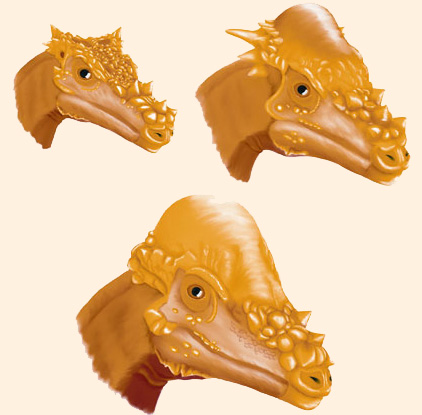
Three different dinosaurs — Dracorex, Stygimoloch and Pachycephalosaurus (clockwise from top left) — might really be the juvenile, teen and adult of the same dino.
Holly Woodward
A new twist in an old story about dinosaur bones sounds like a pixie tale for fossil fans: Once upon a time, scientists revealed three different dinosaur skulls in the northern United States. The first skull, found in 1931, was big and round. The second, found in 1983, was lesser and narrower—and had spikes sticking out of the back of its head. The third, which had horns on its nose, was found in 2006. This was the minimum skull of all.
Like all good tales, there’s a revelation at the end of this dino story. Scientists have long thought that these three skulls belonged to three dissimilar kinds of dinosaurs. But don’t inform that to Jack Horner, a paleontologist at the Museum of the Rockies in Bozeman, Montana. He says that’s possibly not true. According to a new study by Horner and his team, the three skulls are more liable from a kid, teenager and adult of the similar kind of dinosaur.
All three dinosaurs lived about 65 million years past in an area now known as Hell Creek, in Montana and South Dakota. The technical name for the first, largest-skulled dinosaur is Pachycephalosaurus wyomingensis. The second, with the spikes, is Stygimoloch spinifer, which means horned mischievous sprite from the river of death. The third dinosaur takes its name from the globe of Harry Potter—it is called Dracorex hogwartsia¬, which means dragon king from Hogwarts.
Horner began to suspect the fact about the three skulls after he heard about studies of duck-billed dinosaurs. In those studies, scientists found that a set of skulls that all looked dissimilar were found to be from different ages of the similar type of dinosaur. To investigate his hunch, Horner and his group studied bone fragments from the three thickheaded skulls.
Dinosaur
It’s real simple to tell young bone from old bone, Horner told Science News. Young bones are still growing and require a lot of blood flow, so they have more tunnels and passageways for blood vessels. (With all the tunnels and holes, the insides of these bones look a small like sponges.) Older bones are more dense, which means they look more solid and don’t have as numerous tunnels and passageways going through.
Horner and his team found that the largest skull had few tunnels in it, which suggests the skull comes from an adult dinosaur. The two lesser skulls both had many tunnels, which suggest that those dinosaurs were younger when they died.
The scientists found other proof: They took CAT scans, or special pictures alike to X-rays, of the smaller skulls and saw that the bones had not yet grown entirely together, as they do in adults.
Horner’s method of studying the bone structure of skulls is a new way to seem at dinosaurs. In the past, people have been very unwilling to cut open skulls and look at their bone histology, he told Science News. This will show them you can get a terrible lot of information from doing that.
The Museum of the Rockies, where Horner works, has the biggest collection of dinosaur bones in the world—as well as the largest T. rex skull ever establish. With his new discovery, Horner fortuitously made a lot of work for himself.
I made a brand new dinosaur hall at the museum three years past, and now I have to alter it, he said. He may also have made a lot more work for other scientists. Future studies may reveal that some other dinosaur bones also came from the similar type of dinosaur at different ages, rather than from dissimilar types of dinosaurs.
For more information related to dinosaurs, visit rareresource.com.
Fossil Ruins State Agricultural Chemist of Maryland
Posted by Dinosaurs World at 10:47 PM
The geological researches of Mr. P.T. Tyson, State Agricultural Chemist of Maryland, have lately brought to light some very interesting fossil ruins, which have been emtombed during perhaps countless ages in the iron hills between this town and Baltimore.
The formation consists mainly of thick beds of lead-colored clays with lignite. The iron ore is in the form of bulky nodules, and consists of the carbonate of iron. The fossils revealed are:
1. Fossil teeth, which have been completely investigated by Dr. Christopher Johnston, of Baltimore, and resolute to those of a Theodont Saurian, not hitherto described.
We regret to learn that numerous vertebrae, which doubtless formed part of this enormous animal, and which were thrown out by the ore diggers at Mr. Tyson reached the place.
This Saurian has been named, conditionally by Dr. Johnston, "Astrodon," from the stellated appearance of cross sections of the teeth below the microscope.
2. At a petite distance from where the Saurian remains had been buried was found a fragment of what must have been a rib of a big Cetacean.
3. Also, about six feet in length and more than two feet in diameter, the trunk of a tree totally silicified, or, in popular language, "turned into stone." Dr. Johnston's microscopic investigations confirm this to have belonged to the coniferous or languish family.
All the over were found about 220 feet above the stage of tide water.
4. Above one mile far, on the farm of Dr. Theodore Jenkins, a vegetable fossil was found by Dr. J. which belongs to the cycades, (a tribe of tropical plants,) like the existing sago palm frequently seen in our hothouses. It is shaped somewhat like the pine-apple, and is about eighteen inches tall and fifteen inches in diameter, and is also silicified.
These discoveries show that the clays and iron ore ranging from Washington, via Baltimore, to the environs of Elkton, constitute secondary strata possibly older than the cretaceous green sand of New Jersey. In fact, the investigations of Dr. Johnston stipulate that the Saurian teeth may have belonged to a much older period.
The continued inclement weather since these fossils were discovered has arrested additional researches for the present, but we are informed that they will be resumed by Mr. Tyson untimely in the ensuing spring. It is his opinion that the cretaceous green sand, so mainly and usefully applied as marl in New Jersey, may be expected to rest upon the southeastern edge of this iron ore structure, and be reachable within a few miles of the Washington and Baltimore railroad.
This must not be perplexed with the eocene green sands or marls of Charles, Prince George's, Anne Arundel, Cecil, and Kent counties of Maryland, and which are more or less watery with siliceous sand. The lower beds of the Jersey green sand or marl are almost free from siliceous sand. It contains from eight to twelve percent of potash, and is highly prized as a dung. It will prove to be a precious resource if it shall be found in Maryland contiguous to a railroad or tide-water. This article is mainly exported from New Jersey, and enters into the composition of some of the synthetic fertilizers imported from New York or its vicinity.
What amazing changes must have taken place in this part of the world since Whales and Saurians were entombed upon this (then) boggy coast! The ruins of the Saurian and Cycas indicate that a tropical weather then prevailed in this latitude. At the same time also almost the only portion of what now constitutes the only portion of what now constitutes the dry earth of Maryland and Delaware was north and west of a curved line drawn from Wilmington, near Elkton and Baltimore, to Washington. All the residue, comprising half of Maryland and almost the whole of Delaware, was covered by the waters of the ancient sea.
For more information related to dinosaurs, visit rareresource.com.
Sunday, March 20, 2011
The carnivorous dinosaur Allosaurus has been known since the late 1800s. This theropod was first documented in 1869.
* Allosaurus fragilis meaning "fragile, different reptile" lived approximately 145-150 million years ago during the Late Jurassic Period, with a recorded geographic range in Wyoming, Montana, Colorado, New Mexico, South Dakota, Utah, Oklahoma and Portugal (Glut, 1997; Prez-Moreno and Chure, 1999).
* It is known to reach 12 meters in length, 4.5 meters in height, and may have weighed up to 2 tons as an adult.
* A fragilis was one of the top predators of its time and is found primarily in the Morrison Formation.
* It lived on the lowland floodplains of the Western Interior in an enviAllosaurusronment similar to some of the large plains of Africa today (Russell, 1989).
* Allosaurus was the most common large carnivore of the Late Jurassic in North America.
* Strong forelimbs with sharp claws, powerful hind legs and recurved, dagger-like teeth are evidence that Allosaurus was a formidable predator.
* During the Late Jurassic, herds of plant-eating sauropods (such as Apatosaurus) were constantly on the move in search of food to satisfy their large appetites.
* Predators, such as Allosaurus, may have followed these herds, preying on the young and weak.
* Although it was much smaller than the sauropods, quite possibly Allosaurus hunted in packs to bring down larger prey. Like many meat eaters, it may also have been a scavenger.
For more information related to dinosaurs, visit rareresource.com.
Respiratory System of Dinosaurs
Posted by Dinosaurs World at 10:24 PM
As we all know that the birds' lungs obtain air during the respiratory process (during both the inhalation as well as exhalation process).The air sacs do all the "pumping" and the lungs simply absorb oxygen.
Since 1870 onwards scientists have generally accepted that the post-cranial skeletons of many dinosaurs contained many air-filled cavities especially in the vertebrae. Pneumatization of the skull is found in both synapsids and archosaursu, but postcranial pneumatization is found only in birds, non-avian saurischian dinosaurs, and pterosaurs.
For a long time these cavities were regarded simply as weight-saving devices, but Bakker proposed that they contained air sacs like those that make birds' respiratory systems the most efficient of all animals.
John Ruben et al. (1997, 1999, 2003, 2004) disputed this and suggested that dinosaurs had a "tidal" respiratory system (in and out) powered by a crocodile-like hepatic piston mechanism - muscles attached mainly to the pubis pull the liver backwards, which makes the lungs expand to inhale; when these muscles relax, the lungs return to their previous size and shape, and the animal exhales. They also presented this as a reason for doubting that birds descended from dinosaurs.
Researchers have presented evidence and arguments for air sacs in sauropods, "prosauropods", coelurosaurs, ceratosaurs, and the theropods Aerosteon and Coelophysis.
Three explanations have been suggested for the development of air sacs in dinosaurs:
• Increase in respiratory capacity.
• Improving balance and maneuverability by lowering the center of gravity and reducing rotational inertia.
• As a cooling mechanism. It seems that air sacs and feathers evolved at about the same time in coelurosaurs. If feathers retained heat, their owners would have required a means of dissipating excess heat. This idea is plausible but needs further empirical support.
For more information related to dinosaurs, visit rareresource.com.
Dinosaur discoveries
Posted by Dinosaurs World at 9:36 PMThursday, March 17, 2011
August 2009 A new species of sauropod, nicknamed Zac, is found on a sheep farm in Queensland, Australia. The fossil of the large plant-eating dinosaur dates back 97m years.
July 2009 Three more dinosaur fossils, roughly 100m years old, are found in Australia. The carnivorous dinosaur Australovenator wintonensis, is dubbed Banjo. The other two, both herbivores, are named Wintonotitan wattsi (Clancy) and Diamantinasaurus matildae (Matilda).
June 2009 The discovery of a new dinosaur in China is announced. The 160m-year-old ostrich-like dinosaur is named Limusaurus inextricabilis.
October 2008 The bird-like Epidexipteryx, dated at between 152m and 168m years old, is discovered in China.
February 2008 Two new types of carnivorous dinosaur are identified from 110m-year-old fossils found in the Sahara desert eight years earlier. Kryptops palaios had a short, horn-covered snout while Eocarcharia dinops had blade-like teeth.
For more information related to dinosaurs, visit rareresource.com.
How I got to know thunder thighs, the dinosaur with a fearsome kick
Posted by Dinosaurs World at 9:30 PM
"There is something fascinating about science," Mark Twain wrote. "One gets such wholesale returns of conjecture out of such a trifling investment of fact."
The question "how do they know that?" is always quick to arise in response to any scientific discovery, as the comments on any Guardian science article confirm. Quite right too. It's the key question that scientists should always ask, and always be ready to answer about their own work.
In my own science, palaeontology, that question looms large. Small animals can be quickly buried and fossilised, but larger corpses are more likely to be scavenged and broken up, or decompose. So the bigger the animals we study, the less fossils we generally get to work with. I work on the long-necked sauropods, the largest of all dinosaurs, which grew to 70 tonnes or more. The great majority of sauropod species are known from only a single specimen each, and most of these are horribly incomplete.
My own baby, Xenoposeidon, named in 2007, is based on part of a single vertebra , and there are plenty of others known only from similarly scanty remains. How can we know anything about an extinct animal when we work from so little evidence?
The discovery of our newest sauropod, Brontomerus mcintoshi, was announced last month. Happily it is based on more bones than Xenoposeidon, but still only about 10% of a whole skeleton. You might legitimately ask, how can we reconstruct an animal bigger than an elephant, and even speculate about its behaviour, when all we have is a set of bones that fits comfortably on a one-metre-square table?
First of all, the amount of a skeleton that you have can be misleading. The Brontomerus bones include a shoulder blade and a hip bone – only one of each, both from the left side – but because skeletons are symmetrical these bones convey as much information as if we had both the left and right versions. Similarly, we have one vertebra from the middle of the tail. The vertebrae do change along the tail, but the change is slow, so any given vertebra will be very similar to the few that were before and after it. We have only one complete rib, but that tells us something about the other ribs.
In theory, a skeleton that is less than 50% complete could tell you all there is to know about the animal.
The few preserved Brontomerus bones also give us an idea about the shape and size of the animal. By comparing these bones with those known from more complete sauropod skeletons, we can get some sense of where it fits into the family tree. And by comparing the size of our dinosaur bones with the analogous bones in related animals, we can get a broad sense of how big our beast was.
It can be a bit unnerving to see how precisely these imprecise estimates get reported, though. For example, our four attempts at estimates for the total mass of the animal yielded 4,666, 6,041, 6,300 and 9,563kg – an uncertainty factor of more than 2 – but this necessarily got condensed down to "around 6 tonnes" for the press release. Still, that's at least enough to know that it was roughly elephant-sized rather than cow-sized or whale-sized.
Many parts of the Brontomerus skeleton are completely missing – we have nothing at all from the skull, neck or limbs. Yet we named the dinosaur after its hind limbs – Brontomerus means "thunder thighs". How can we do that when we don't have any of the limb bones?
Because bones don't work in isolation. Animals' bodies are complex objects, and units of the skeleton work together. Hind limb function depends on the pelvis, the legs themselves and the tail, but if we have the pelvis (or in our case part of the pelvis), we can draw some conclusions about how the whole complex worked.
In this case, we have an ilium, the uppermost of the three bones that make up the pelvis and the one that most of the leg muscles attach to. (We can be confident that was true in dinosaurs because dissections of birds and crocodilians, their closest living relatives, show that these muscles work in broadly similar ways in both groups, forming an evolutionary bracket around dinosaurs.)
The ilium of Brontomerus tells us a lot. The lower margin of a dinosaur ilium forms part of the hip socket, and the upper part consists of a flattish plate of bone where muscles were anchored. In Brontomerus, the plate at the front of the ilium is hugely enlarged compared with other sauropods, so we deduce that the muscles that attached there were correspondingly enlarged. (These are called protractor muscles, and pull the leg forward.) The surprising aspect is that it's only the front part of the plate that's enlarged, while the part behind has shrunk down to almost nothing. Does this mean that Brontomerus had weak retractor muscles?
Not necessarily. Once again, comparisons with living animals come to the rescue. In crocs, the main retractor muscles attach not to the ilium but to the tail base, and details of the bones indicate that the same was true in dinosaurs. So it's possible that Brontomerus had extra-strong retractors as well as protractors. Unfortunately we don't know, because we have no vertebrae from the base of the tail.
So what were the large protractor muscles doing? If the retractors were not also enlarged, then the leg was optimised for being moved quickly forwards: in a word, kicking. In the absence of evidence for strong retractors, and especially in the light of a reduced attachment area for these muscles at the back of the ilium, kicking seems like the simplest and most likely explanation, so that's the angle that we played up in the media.
For more information related to dinosaurs, visit rareresource.com.
Rare 89-million-year-old Flying Pteranodon Fossil may be World's Oldest
Posted by Dinosaurs World at 11:05 PMWednesday, March 16, 2011
Fossilized bones discovered in Texas from a flying reptile that died 89 million years ago may be the earliest occurrence in the world of the prehistoric creature known as Pteranodon. The only reptiles to dominate the ancient skies, pterosaurs had broad leathery wings and slim torsos.
Pteranodon was a type of pterosaur that lived about the same time as some dinosaurs, about 100 million to 65 million years ago. Previously, Pteranodon bones have been found in Kansas, South Dakota and Wyoming in the Niobrara and Pierre geological formations.
This likely Pteranodon specimen is the first of its kind found in Texas, according to paleontologist Timothy S. Myers at Southern Methodist University, Dallas, who identified the reptile. The specimen was discovered north of Dallas by an amateur fossil hunter who found various bones belonging to the left wing.
The specimen identified by Myers is an adult pterosaur of the toothless variety and, while larger than most birds, wasn't among the largest pterosaurs, Myers said, noting it had a wing span between 12 and 13 feet, or 3.6 to 4 meters. It was discovered in the Austin Group, a prominent rock unit in Texas that was deposited around 89 million years ago, early in the geological time period called the Late Cretaceous.
Pterosaurs, many of which survived on fish, lived at a time when a massive ancient sea cut across the central United States. The Western Interior Seaway was a shallow body of water that split North America in half from the Arctic Ocean to the Gulf of Mexico.
More than a thousand Pteranodon fossils have been unearthed from the middle part of the seaway. But no definitive Pteranodon specimens have emerged from the southern part that is now Texas. The SMU specimen, if it is Pteranodon, would be the first discovered so far south in the Western Interior Seaway, said Myers, a postdoctoral researcher in SMU's Huffington Department of Earth Sciences.
Myers reported and described the specimen in "Earliest Occurrence of the Pteranodontidae (Archosauria: Pterosauria) in North America; New Material from the Austin Group of Texas" in the Journal of Paleontology.
Left wing suggests Pteranodon; cause of death a mystery
Key to identifying the SMU fossils as Pteranodon is a humerus of 5.7 inches, or 14.5 centimeters. The humerus is the uppermost bone in the wing and attaches to the torso. The humerus of the SMU specimen, while complete, did suffer some damage during fossilization when it became compressed and distorted through millions of years of compaction.
"If it wasn't crushed so badly, it would be possible to determine if it really is Pteranodon," Myers said. "These bones are easily flattened. They are hollow inside, because they have to be lightweight to allow a pterosaur to fly. So, they compress like a pancake as they're embedded in layers of rock."
While it's difficult to narrow the humerus definitively to a specific genus and species, some features clearly identify the specimen as part of the Pteranodontidae family, most likely the genus Pteranodon. It exhibits, for example, the prominent warped deltopectoral crest that is characteristic of members of the Pteranodontidae family, called pteranodontids, he said.
Discovered along with the humerus were parts of the elongated fourth finger that in pterosaurs forms the wing. The SMU specimen's metacarpal — at 20 centimeters — is incomplete, missing an estimated 37 percent of its length.
The fossils do not solve the mystery of the reptile's cause of death, Myers said. But it appears the animal probably died in flight over the sea and then fell into the water. Its carcass probably floated for some time, so that when the flesh decomposed the bones separated at the joints, known as "disarticulation," before they settled to the sea floor and were buried.
"We know it was disarticulated when it was buried, because the bones weren't preserved in correct anatomical position," Myers said. "Abrupt truncation of the broken end of one of the bones and infilling of the break with sediment also indicates that the breakage and disarticulation took place prior to burial."
May be oldest Pteranodon in world
If the specimen represents Pteranodon, Myers said, it would be the oldest one in the world by 1 million to 2 million years, and the second oldest pteranodontid in the world.
Pterosaurs were alive from the Late Triassic — more than 200 million years ago — to the Late Cretaceous, evolving from small-bodied creatures to some of the largest animals to ever inhabit the skies, Myers said. An older pteranodontid specimen, belonging to the genus Ornithostoma, previously was identified in England.
"Any pterosaur material is fairly rare to find unless you have exceptional preservation conditions. They are frail, fragile bones, and they require rapid burial to be well-preserved," Myers said. "The SMU specimen was deposited relatively far offshore in deep water, perhaps 50 to 80 feet deep. It's fairly exceptional because of the number of elements. Typically you'll only find one piece, or one part of a piece in the local rock."
During the Early Cretaceous, many types of pterosaurs lived around the world, Myers said. The earliest ones had thin, razor-sharp teeth. In the transition from Early to Late Cretaceous, the toothed variety disappear from the fossil record and toothless forms, like the SMU specimen, become more common, he said.
Dallas area specimens illustrate pterosaur evolution
North Texas is fortunate to have had both the toothed and toothless kinds discovered in the area, illustrating the evolutionary transition, noted Myers.
Besides the toothless specimen just identified by Myers, an older toothed pterosaur, Aetodactylus halli, previously was discovered in the Dallas area. Aetodactylus, also identified by Myers, lived 95 million years ago.
"This new specimen adds a lot more information about pterosaurs in North America," Myers said. "It helps constrain the timing of the transition from toothed to toothless because there's only a few million years separating this specimen and Aetodactylus."
Amateur fossil collector Gary Byrd of Rockwall, TX, discovered the new SMU pterosaur fossils about 10 years ago.
A roofing contractor who keeps an eye out for fossils, Byrd made the find after stopping to look at two freshly excavated culverts while driving through a new subdivision in Collin County. Using a hammer and pick he dug out the bones and brought them to SMU paleontologists Louis Jacobs and Dale Winkler. Jacobs and Winkler indicated the fossils were likely a pterosaur. Byrd donated the fossils to SMU's Shuler Museum of Paleontology.
"I found a couple parts of a fish, and then when I saw these my initial thought was that they weren't fish," Byrd recalled. "I kind of knew it was something different — a birdlike thing. It's very rare you find those thin, long bones."
This isn't the first time Byrd has hit it lucky finding fossils. In 1994, he discovered dinosaur bones that he donated to SMU's Shuler Museum. The specimen was identified as a rare primitive duck-billed dinosaur and named Protohadros byrdi after Byrd.
For more information related to dinosaurs, visit rareresource.com.
Children discover 'rare' fossils at Cotswold Water Park
Posted by Dinosaurs World at 11:03 PM
Two children have found "rare" specimens of a fossilised sea creature at the Cotswold Water Park.
Emily Baldry, five, from Chippenham, discovered the Rieneckia ammonite during a fossil hunt organised by the Cotswold Water Park Society on Sunday.
Hugo Ashley, from Poulton, and his grandfather also found an ammonite cadoceras, and another Rieneckia ammonite.
A society spokeswoman said Rieneckia ammonites were "extremely rare".
Ammonites were free-swimming molluscs of the ancient oceans, living around the same time as dinosaurs.
'Quite phenomenal'
Society spokeswoman Jill Bewley said: "The chances of finding something like this [Rieneckia ammonites] are really, really slim.
"It's the proverbial needle in a haystack so to hit upon something like this is quite phenomenal."
After Emily hit upon the fossil with a spade, her father and palaeontologist Dr Neville Hollingworth helped her dig out the block of mudstone the 162.8 million-year-old object, which had spikes to ward off predators, was encased in.
A range of other fossils, including many ammonites, were also found during the hunt, in a sand and gravel quarry within the water park.
Ms Bewley said that once work to expose the Rieneckia ammonite, which measures about 40cm (16in) in diameter is complete, it will go on display at the Gateway Information Centre along with a range of other fossils.
She said Dr Hollingworth found another Rieneckia ammonite in a similar quarry in the park several years ago.
The 42 sq mile site of the Cotswold Water Park, which has 150 lakes, is on the Gloucestershire-Wiltshire border.
During the Jurassic period, 165 million years ago, the area was a warm shallow sea
For more information related to dinosaurs, visit rareresource.com.
Dinosaurs are alive in Port Republic
Posted by Dinosaurs World at 10:55 PMTuesday, March 15, 2011
Students in Marilyn Tabasso’s second-grade class enjoy learning about dinosaurs and other prehistoric reptiles.
They made models of various dinosaurs and researched many of their favorite reptiles that roamed the earth millions of years ago.
“The children are masters of dinosaur identification,” Tabasso said. “They have done a fabulous job.”
The class even added some of the dinosaurs and reptile names to their weekly spelling tests.
“It’s amazing how well they can spell Tyrannosaurs Rex, Ichthyosaurus, Pteranodon and many others,” the teacher said. “We definitely had a lot of fun.”
For more information related to dinosaurs, visit rareresource.com.
Study traces morel mushrooms back to days of the dinosaur
Posted by Dinosaurs World at 10:53 PM
Now that spring is in the air, our minds are turning to morels. And thanks to a new study published in Fungal Genetics and Biology (you do subscribe, yes?), we can swoon over this honeycomb-capped fungi with a little more knowledge.
Turns out morels have been on the planet since the time of the dinosaurs, splitting off from other fungal species 129 million years ago at the beginning of the Cretaceous period. Since then, morels have evolved into 177 related species, and western North America -- particularly the Pacific Northwest -- has been an evolutionary hot spot.
"Oddly enough, most animal species aren't particularly attracted to morels," says Oregon State University researcher Nancy Weber, who participated in the study. "A few slugs and other things will eat them. But humans have probably been eating them for about as long as there have been humans."
The newly published genetic analysis, one of the most detailed ever done, also suggests what conservation efforts will be needed to protect the morel for centuries to come. As to what accounts for their exceptional deliciousness when sautéed in butter, that's a research question we'll be happy to investigate.
For more information related to dinosaurs, visit rareresource.com.
New Dinosaur Species Is Titanic
Posted by Dinosaurs World at 10:15 PMMonday, March 14, 2011
An oddball fossil skull in an Oklahoma museum may represent a new kind of dinosaur, the earliest giant horned species yet found.
The 1.2-meter-long partial skull, found along with some bones, deserves to be recognized as a species in its own right, says Nick Longrich of Yale University. The specimen was originally found in 1941 in 74-million-year-old rock in northwestern New Mexico. A reconstruction currently glares down at visitors in the Sam Noble Museum of Natural History in Norman, Okla. Until now, paleontologists treated the find as a weirdly huge specimen of the Pentaceratops dinosaurs known from the Southwest region.
Click here to find out more!
This beast probably weighed 6,550 kilograms, rivaling Triceratops and modern-day elephants. The head, one of the biggest of any known land animal, was an estimated 2.6 meters long. In the June Cretaceous Research, Longrich christens it Titanoceratops ouranos. The new species would add another branch of giants to the Triceratops family tree and would mean that giant size evolved some 5 million years earlier than previously thought, he says.
If Longrich is right that the giants began to diversify earlier, “It would suggest there are a lot of undiscovered horned dinosaurs sitting around out there,” says Andrew Farke of the Raymond M. Alf Museum of Paleontology in Claremont, Calif.
The skull discovered in 1941 spent 54 years in museum storage before researchers cleaned and prepared it for display by filling in missing parts, assuming it was a species of Pentaceratops.
Now, Longrich says he has looked at the fossil in a new light. Comparing traits across horned dinosaurs, he found that the skulls’ outsized nostrils, the position of its nose, some of the cavities inside its skull and many more features resemble not Pentaceratops but those of the Triceratops and Torosaurus giants. In scoring dozens of traits, overall the fossil looked like an early relative of those giants, he concludes.
The specimen has been “problematic,” Farke acknowledges. “Right now, I’m skeptical but convincible on the validity of Titanocerotops,” he says. For the moment, he is inclined toward the alternative view that the fossil is what it was originally thought to be: an outsized individual of the not-particularly-titanic Pentaceratops. Differences between the specimen’s bones and those of the smaller Pentaceratops could have developed while growing to such a huge size, Farke says.
John Scannella and Denver Fowler at the Museum of the Rockies at Montana State University in Bozeman also consider the specimen a big adult Pentaceratops. “If you do find a mature form it will likely look different from preceding growth stages—we see this in every growth series that has been described for a dinosaur,” Scannella says.
Mistaking dinosaurs at different stages of growth for different species may be a widespread problem, says Jack Horner, also at the Museum of the Rockies. “I think most of the dinosaur specimens we find represent subadult sizes,” he says. He and Scannella last year argued that what’s now considered the species Triceratops is just a younger growth stage of a different horned dinosaur, Torosaurus.
For more information related to dinosaurs, visit rareresource.com.
Dinosaurs Keep Watch Over Cabazon
Posted by Dinosaurs World at 10:13 PM
Nope, that’s not an illusion - those are two dinosaurs staring at you from the side of the 10 freeway in Cabazon.
Dinny the Dinosaur and Mr. Rex have been keeping watch in Cabazon for decades. The creation of Claude Bell, a Knott’s Berry Farm sculptor and portrait artist, the 150 ton Apatosaurus (Dinny) and 100 ton Tyrannosaurus rex (Mr. Rex) were completed in 1975 and 1986, respectively. The goal of the dinosaurs was to bring customers to Bell’s Wheel Inn Cafe, right next to the giant sculptures.
Today, visitors come from around the country to see the dinosaurs that have made appearances in Pee-wee’s Big Adventure and The Wizard. There is a gift shop located inside of Dinny, featuring dinosaur merchandise and collectibles. About three years ago, the new owners opened a museum with robotic dinosaurs and small rides for children. The company believes in Creationism, and the new catchphrase of the attraction is “By design, not by chance.”
On a recent weekday, only a few visitors were on hand, standing at the giant feet of Mr. Rex and perusing merchandise inside Dinny.
“We’re busier on weekends and three days weekends,” said employee Jeff Brock of Redlands. “We’ve had people come from as far as Missouri, and a lot of military people come from the local base.”
Katharina Napoletano, 9, came from Redlands to visit the dinosaurs with her brother, grandmother and aunt.
“My brother loves dinosaurs, so we brought him out here after school for a fun little trip,” Napoletano said. “The dinosaurs are awesome.”
She was surprised to see how lifelike the sculptures are.
“They look real and the actual size of a dinosaur,” she said. “You don’t get to see that every day.”
Her younger brother Eric, 5, was intrigued by the items for sale inside Dinny.
“There are so many toys and a lot of candy,” he said. “This is fun.”
He was surprised when his grandmother pulled up to the dinosaurs, because he had never seen them from the freeway before or visited Cabazon.
“They are so, so cool,” he said. “I want to come back again tomorrow.”
For more information related to dinosaurs, visit rareresource.com.
Dinosaur sighting at Hunter Valley Gardens
Posted by Dinosaurs World at 10:12 PM
There have been several reported dinosaur sightings around Hunter Valley Gardens over the past few days. Residents of the area are excited to report that they are expecting a longer visit from their prehistoric reptile friends over the April school holidays.
From Monday 11th to Thursday 21st of April, families and budding palaeontologists are invited to take a journey through prehistoric Australia.
Erth Australian Dinosaur Petting Zoo (11am & 2pm Daily. No 2pm Show on Thursday 21st April and No Shows on Monday 18th April)
The most exciting attraction of the day is the Erth Australia Dinosaur Petting Zoo. Children will be able to help feed, water and care for the prehistoric marvels with simple lessons in animal husbandry. Hunter Valley Gardens also guarantees that all the dinosaurs at the petting zoo are herbivores so children will not be any danger.
Dinosaur Craft (10am to 2pm)
Children can paint and colour in Dinosaur pictures or make their own Dinosaur foot print, as a memory of the day. They can take home their own special dinosaur craft to remind them of their prehistoric day.
Treasure Hunt
Upon entry, children will be issued with a treasure hunt questionnaire. Throughout the day they can fill it out at their own pace, learning lots of interesting trivia details as they explore the many themed spaces at Hunter Valley Gardens. Once completed, the questionnaire can be exchanged for a very special prize.
Hunter Valley Gardens Train ($5 Children, $7 Adults) & Story Book Jumping Castle (10am to2pm)
Hop aboard the Hunter Valley Gardens Express! Families can be taken on an incredible train tour around the Gardens. Or if the kiddies are still beaming with energy, let them jump around on the Storybook Garden Jumping Castle.
So don’t miss out on meeting the Hunter Valley’s Gardens newest inhabitants this April School Holidays!
Entry to the Gardens is $23.50 per adult and children 16 and older, $12 for children between 4 – 15 years of age, with children 3 years and under admitted free.
For more information related to dinosaurs, visit rareresource.com.
Dinosaur-like extinction on the cards
Posted by Dinosaurs World at 9:58 PMSunday, March 13, 2011
Life on Earth is hurtling towards extinction levels comparable to those following the dinosaur-erasing asteroid impact of 65 million years ago, propelled forward by human activities.
Scientists from the University of California, Berkeley, believe that if current extinction rates continue unabated, and vulnerable species disappear, Earth could lose three-quarters of its species as soon as three centuries from now.
''That's a geological eyeblink,'' said Nicholas Matzke, a graduate student at UC Berkeley and author of a paper presenting the doom-and-gloom scenario. ''Once you lose species, you don't get them back. It takes millions of years to rebound from a mass extinction event.''
Advertisement: Story continues below
This means that not too far in the future, backyards might not be buzzing with bees, bombarded by seagulls or shaded by redwood trees. And while that might seem far off, species already are disappearing on a global scale.
In recent history, we've lost the dodo bird and the passenger pigeon, the Javan tiger and the Japanese sea lion. Amphibians, mammals, plants, fish - none are immune to going the way of the dinosaurs, courtesy of the human impact on fragile ecosystems.
Such enormous losses have occurred only five times in the past half-billion years, during events known as ''mass extinctions''. The best-known of these occurred 65 million years ago, when an asteroid collided with Earth, sending fiery dust into the atmosphere and rapidly cooling the planet.
These ''Big Five'' events set the extinction bar high: to reach mass wipe-out status, 75 per cent of all species need to disappear within a geologically short time frame, meaning that Earth is currently on the brink of the sixth mass extinction.
To determine whether current losses could equal these mass extinction rates, scientists compared recent rates with species die-offs during the Big Five, taking into account currently endangered species.
They found that while rates are dramatically higher than expected, the percentage of vanishing species is not elevated - yet.
''The good news is, we still have most of what we want to save,'' said Berkeley palaeontologist and lead study author Anthony Barnosky. ''But things are clearly going extinct too fast today.''
The paper, published in this week's issue of Nature, resulted from a graduate seminar that Professor Barnosky organised in autumn 2009.
Focusing on our milk-bearing relatives, mammals, he and students used fossils to compare extinction rates with more modern data, wanting to answer whether we really are seeing the sixth mass extinction.
Stanford University biologist Paul Ehrlich, who was not involved in the study, said evidence of the sixth extinction is all around. For years, he studied the Bay Checkerspot butterfly on Stanford's campus - but then, more than a decade ago, the butterfly disappeared from the campus.
For more information related to dinosaurs, visit rareresource.com.
Paleobotanist discusses extinction of dinosaurs
Posted by Dinosaurs World at 9:56 PM
Paleobotanist Kirk Johnson is co-author of a recent study concluding that dinosaurs went extinct after an asteroid crashed into Mexico 65.5 million years ago, blowing debris around the world, knocking down forests and causing tsunamis and earthquakes.
It is a hypothesis that first emerged in 1980 and got some confirmation in 1990 when researchers discovered the 120-mile-wide Chicxulub crater in Mexico. But the new study, published in the journal Science in March, is much more definitive, put together by 41 scientists using past studies of Chicxulub, fossil records and analyses of debris embedded in a finger-thin rocky layer of the Earth to bolster the asteroid explanation.
Johnson isn't a dinosaur expert. His focus is plant fossils from the period before and after the asteroid impact, particularly those found in that finger-thin layer, known as the K-T boundary. He has dug up fossils all over the world, including in the American West, Mongolia, India, the Amazon, Alaska's Bering Sea and the rainforests of New Zealand.
In a recent interview, Johnson spoke by phone at the Denver Museum of Nature & Science, where he is chief curator and vice president of research and collections, about how one becomes an expert in 65.5-million-year-old plant life.
For more information related to dinosaurs, visit rareresource.com.
Old bones yield new age of dinosaurs
Posted by Dinosaurs World at 9:51 PM
When the rains come and the rivers swell, giant bones tend to wash up in this remote rice-farming corner of Thailand.For years, farmers did not know what they were or what to do with them.The superstitious buried them. Others brought them to Buddhist temples, where monks collected them alongside artifacts and other curios.
"It used to be a taboo -- people didn't want to bring them home," said Varavudh Suteethorn, a paleontologist who has spent the last three decades leading dinosaur excavations. "After we worked for about 10 years in the area, people started to know more about it."
Thailand is known for its beaches, great food and, more recently, its propensity for political protests, but not much for dinosaurs. It turns out that the creatures of prehistory, like the tourists of today, found certain parts of Thailand very hospitable.
Paleontologists say that the Khorat Plateau of northeastern Thailand was teeming with dinosaurs starting about 200 million years ago (Bangkok was under the sea at the time), and that the proof is in the frequency with which villagers find dinosaur bones and other fossils.
Now the message is out: Don't throw away the dinosaur bones.
For more information related to dinosaurs, visit rareresource.com.
Pterosaurs—Lords of the Ancient Skies
Posted by Dinosaurs World at 8:29 PMThursday, March 10, 2011
Three flying reptiles from Earth's distant past glide above the gray Pacific, far beyond the rollers breaking on the shore of Point Reyes, California. They flap their wings slowly for a few beats, gain some altitude, then turn toward the beach. One peels out of formation and dives into the water with a splash, sinking just as far as its shoulders to snatch a fish with its long snout. Then, with a few powerful wing strokes, the beast takes off, using its webbed feet to hop off the waves until it clears the water. As it draws near, the primeval pterosaur transforms into an ordinary brown pelican.
Keven Padian, a paleontologist at the University of California, Berkeley, stands on the beach gazing at the birds through binoculars. Watching coastal birds helps Padian envision the time when pterosaurs occupied the same ecological niche, plunging for fish like pelicans, soaring like gulls, and pecking at the sand like sandpipers.
"Pterosaurs were just the coolest things that were ever in the air," says Padian. "They were the first vertebrates to fly. They did it long before birds and bats. And it terms of size, they pushed the envelope as far as it could go for a flying animal."
Like their cousins the dinosaurs, pterosaurs stand out as one of evolution's great success stories. They first appeared during the Triassic period, 215 million years ago, and thrived for 150 million years before going extinct at the end of the Cretaceous period. Their endurance record is almost inconceivable compared with the span of humans, whose ancestors started walking upright less than four million years ago. Uncontested in the air, pterosaurs colonized all continents and evolved a vast array of shapes and sizes. Of more than 120 named species, the smallest pterosaur measured no bigger than a sparrow; the largest reached a wingspan of nearly 40 feet (12 meters), wider than an F-16 fighter.
Until recently most paleontologists would not have put pterosaurs in the same league as birds in terms of flying ability. Because pterosaurs were reptiles, generations of scientists imagined that these creatures must have been cold-blooded, like modern snakes and lizards, making them awkward aerialists at best.
In the past three decades, however, a surge of fossil discoveries around the globe has prompted researchers to reexamine their views. The emerging picture of pterosaurs reveals that they were unlike any modern reptile. From a fossil discovered in Kazakhstan, paleontologists suspect that pterosaurs had a hairlike covering, perhaps akin to fur. If so, this detail provides evidence of a high-revving, warm-blooded physiology that could sustain the kind of exertion needed to stay in the air. Judging from the skulls of other fossils, scientists reason that many pterosaurs were gifted air-borne predators, built to feed on the wing. They darted after insects, dive-bombed for fish, and soared hundreds of miles over open ocean on extended hunting expeditions.
"For about 150 years pterosaurs were regarded as typical slow-moving, cold-blooded reptiles. People had the idea that pterosaurs could glide, but they couldn't flap their wings," explains Alexander Kellner, a Brazilian paleontologist. "We thought they couldn't take off from the ground."
Pterosaurs first grabbed Kellner's attention when he was a child in Rio de Janeiro, where he became hooked on a television cartoon featuring one. His early fascination might have foundered, but when Kellner was a student, Brazilian scientists started to uncover a mother lode of pterosaur fossils in the northeastern part of the country, on the slopes of the Araripe Plateau. In the past 30 years Araripe has yielded remains of 19 new species, an unrivaled pace of discovery.
For more information related to dinosaurs, visit rareresource.com.